Somewhere in a federal courthouse, under oath, a Google executive answered a question he’d spent years not answering.
Not in a leaked memo. Not in an SEO blogger’s theory post. In sworn testimony, because the U.S. government sued Google — and testimony under oath doesn’t get to be vague.
The question was simple: How does Google actually decide what ranks?
The answer that came out wasn’t a formula. It wasn’t a checklist. And if you’ve spent any time chasing “the algorithm” — that should unsettle you a little.
Hi, I’m Jeff Payne. You’re listening to The Jeff Payne Show, Episode #71: How Google Ranks Pages.
For 25 years, an entire industry has built itself around one belief: That somewhere inside Google is a formula, and if you could just find it — the right keyword density, the right backlink pattern, the right technical fix — you’d win.
The antitrust trial didn’t confirm that belief. It dismantled it.
One of the systems that came up repeatedly in testimony is internally referred to as Navboost. Google’s own Search VP described it under oath as a system that watches what real people actually do with a search result — do they click it, do they linger, do they come back and try something else — and holds onto that behavioral data for 13 months to keep adjusting rankings.
Not 13 minutes. Thirteen months! Google is watching how real humans behave toward your page over more than a year, and using that as one of its core signals.
What that means is there’s no shortcut around real human approval. You can’t fake 13 months of people finding your page useful. You either earn it, or the data eventually says you didn’t.
And it turns out the exact same pattern is playing out in AI search — just with a twist most people are missing.
A survey of 1,000 marketers examined where AI platforms actually pull their citations from — what type of content ChatGPT, Perplexity, and Google’s AI Overviews reach for when answering a question.The finding: no single format wins.
Listicles and roundups lead, but only at 22%.Articles are next at 17%.Product pages at 14%.Then category pages, homepages, community discussions, how-to guides — all of them earning a slice, none of them dominating.
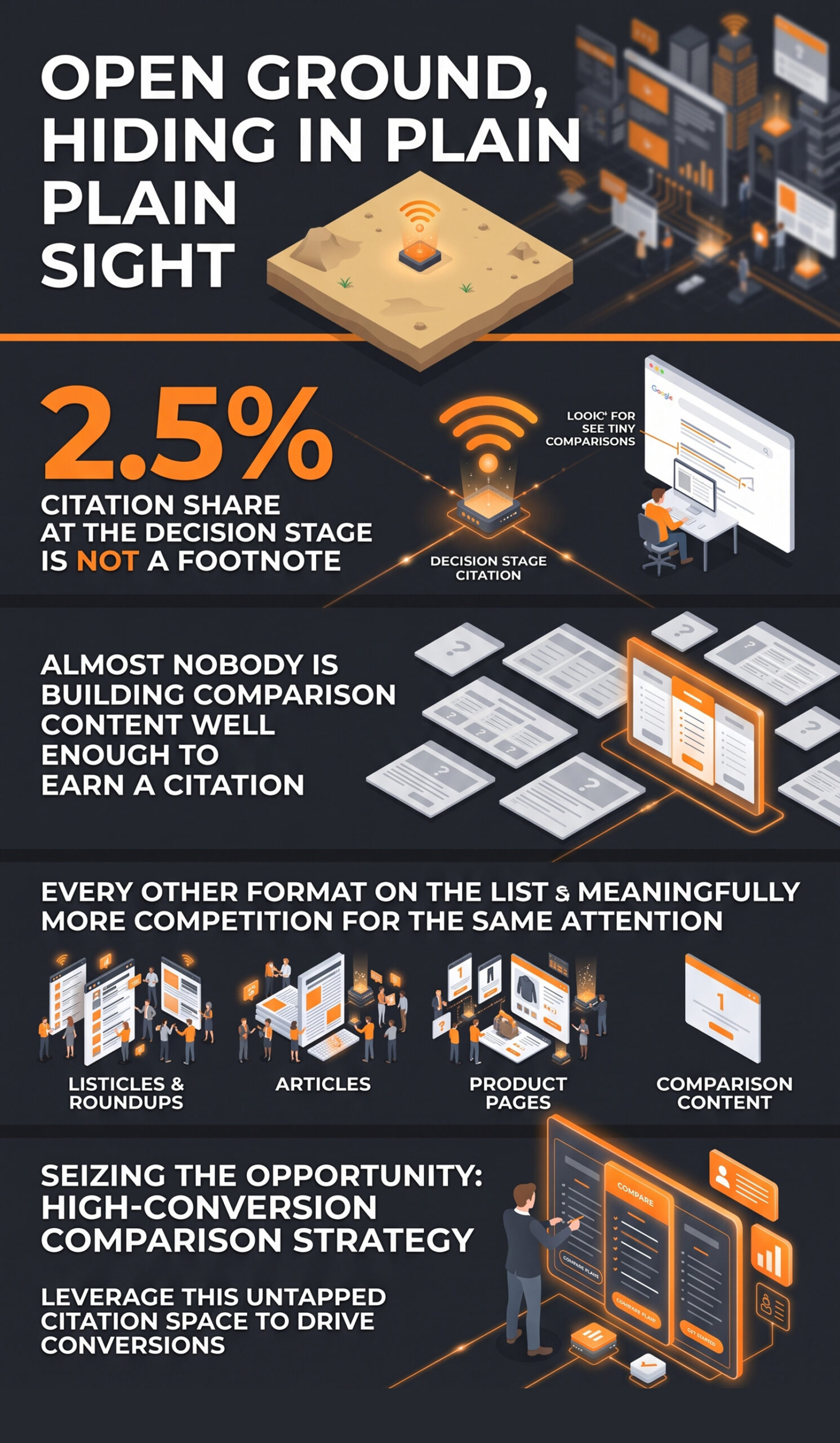
Here’s the number that should actually bother you: comparison and alternative pages — the exact content type someone reads right before they decide who to buy from — capture just two and a half percent of AI citations. The lowest share of any format on the list, at the highest-intent moment in the buyer’s journey.
Almost nobody is investing there. Which means almost everybody is leaving that moment uncontested.
Put those two things next to each other, and you get the same lesson twice.
Google isn’t ranking you on a trick — it’s ranking you on 13 months of whether real people found you genuinely useful. And AI platforms aren’t citing one magic format — they’re pulling from whoever actually built something worth citing, across a wide spread of formats, including the ones — like comparison content — that almost nobody bothers to build well.
The businesses still searching for the trick are optimizing for a system that stopped rewarding tricks a long time ago. The ones pulling ahead are the ones who accepted that visibility now gets earned the slow way — real usefulness, sustained over time, published in more than one format — and started building for that instead.
So here’s the gut check. Not “Do you have good SEO?” Ask yourself this instead: If Google or an AI platform watched how real people behaved on your site for the next 13 months — would that data make the case for you?
And separately — do you have a single comparison page anywhere on your site that actually helps someone choose you over the alternative? If not, that’s not a small gap. That’s open ground.
Sworn antitrust testimony reveals how Google ranks pages. New survey data reveals which content formats AI actually cites. Neither one rewards a shortcut.
WHAT CAME OUT UNDER OATH
For 25 years, an entire industry has operated on a single belief: that somewhere inside Google’s search engine is a formula, and finding it is the path to ranking. Federal antitrust trial testimony has made that belief much harder to hold onto.
Google’s own Search VP testified under oath about an internal system called Navboost — one that tracks real user behavior on search results (clicks, hovers, scrolls, return visits) and retains that data for 13 months to continually adjust rankings. Not a snapshot. Not a one-time check. Thirteen months of real people telling Google, through their actual behavior, whether a page was worth showing.
THE SAME PATTERN, SHOWING UP IN AI SEARCH
A survey of 1,000 marketers examined which content formats AI platforms actually draw on when answering a question — including ChatGPT, Perplexity, and Google’s AI Overviews. The finding: no single format dominates. Listicles and roundups lead at 22%, articles follow at 17%, product pages at 14%, with category pages, homepages, community discussions, and how-to guides each capturing a meaningful share.
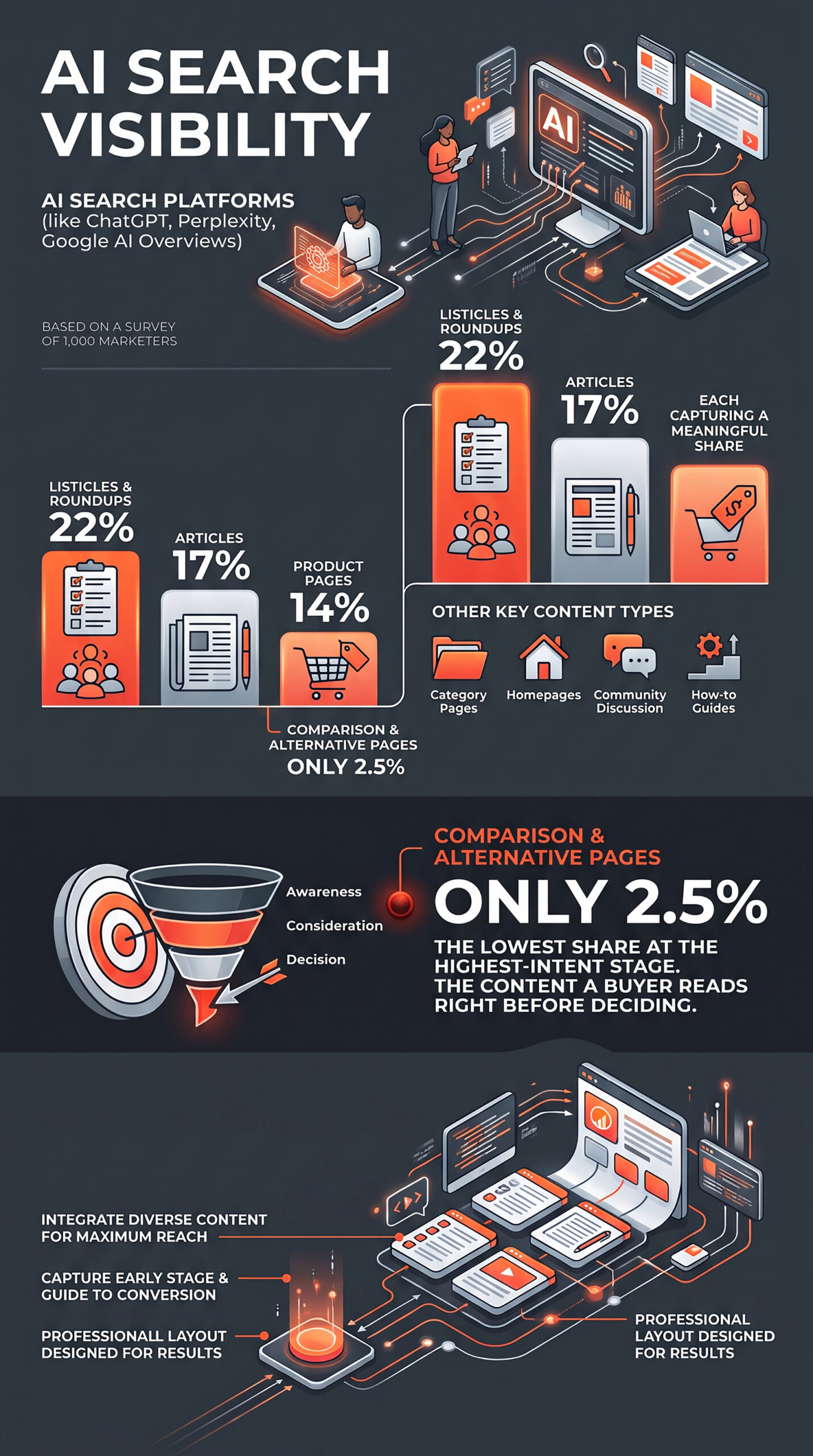
The number worth sitting with is the smallest one. Comparison and alternative pages — the content type a buyer reads right before deciding who to choose — capture just 2.5% of AI citations. The lowest share of any format measured, at the highest-intent stage of the buyer’s journey.
You can’t fake 13 months of real people finding your page useful. You either earn it, or the data eventually says you didn’t.
OPEN GROUND, HIDING IN PLAIN SIGHT
A 2.5% citation share at the decision stage isn’t a footnote — it’s a signal that almost nobody is building comparison content well enough to earn a citation there. Every other format on the list has meaningfully more competition for the same attention.


This is one of the best written, most informative email newsletters I’ve ever read!
Thank you for sharing your expertise, and hope you’re doing well.
Beth Zimmerman
Founder, Executive Director

THE LESSON IS THE SAME LESSON, TWICE
Google isn’t ranking pages on a trick — it’s ranking them on 13 months of whether real people found them genuinely useful. AI platforms aren’t citing one winning format — they’re pulling from whoever built something worth citing, across a wide spread of formats, including the ones most businesses haven’t bothered to build well.
The businesses still hunting for the shortcut are optimizing for a system that stopped rewarding shortcuts a long time ago. The ones pulling ahead accepted that visibility gets earned the slow way — real usefulness, sustained over time, published across more than one format — and built for that instead.
The diagnostic question isn’t whether your SEO is good. It’s whether 13 months of real user behavior on your site would make the case for you — and whether you have a single comparison page that actually helps someone choose you.
Sources: Cyrus Shepard, Zyppy Signal (Aug 17, 2026), on Google antitrust trial testimony; NP Digital / Neil Patel, “Content Types Earning the Most AI Citations” (Aug 2026)
COMPLETE THE FORM TO
BOOK A STRATEGY CALL
"*" indicates required fields

COMPLETE THE FORM TO
BOOK A STRATEGY CALL
"*" indicates required fields
Subscribe and Share – WE APPRECIATE YOUR SUPPORT