A phone rings at a small business in Texas. A sales rep from an online review site calls, looking at the company’s website as she talks. She’s polite. A little careful. “I’m looking at your site here,” she says. “Are you… targeting a foreign audience?”
Because the page isn’t in English, it isn’t in Spanish either. It isn’t in any language.
And it is ranked number one on Google.
Hi, I’m Jeff Payne. You’re listening to The Jeff Payne Show, Episode 117: Google Doesn’t Read: Page 1 for Seven Years, Zero Phone Calls.
That page was an experiment. One of the search industry’s best-known testers, a man who has run controlled tests against Google’s algorithm every year for more than a decade, built a site for a cosmetic-surgery keyword in a Texas city. He wrote the page in placeholder Latin, the filler text designers use before the real words arrive.
Then he did the math. How many times the keyword should appear. Where its variations should sit. Which related terms Google expects to see nearby. He pasted those into the gibberish. Title, headline, a few paragraphs, the web address.
30 days later, it was on the first page. A few weeks after that, it was number one in the map listings and number one in the regular results. Google removed it after an article made it famous. So he did it again, in city after city. By his account, two of those pages have stayed on page one since 2019. Seven years.
Here’s what that experiment tells you, and it is not “SEO is a trick.”
Google doesn’t read. It counts. It isn’t a person with an opinion about your writing. It’s arithmetic: which words, how often, and where. And that arithmetic has barely changed in a decade. The knobs get turned a little each year. The machine is the same machine. Find, crawl, index, rank. That’s the whole thing.
So when someone tells you the rules have all changed and you need the 2026 methods, you are hearing a sales pitch. The fundamentals your marketing team should be executing are the same as they were five years ago. What changes is whether they’ve been done. Done to completion.
But here’s the part of that story I want you to remember.
Those pages ranked for seven years. The contact forms worked. The phone number was live. In all that time, they received zero form submissions. Zero calls. Not one.
The robot counted every word. The buyer didn’t read a single one.
Ranking and being chosen are two different jobs. The math gets you in the room. Something else has to make the sale: a real answer, a real story, and evidence that you’ve done this before for someone like the person reading. That part was never for Google. It was always for the buyer. And a page that wins the first job and loses the second shows up in your marketing report as a success.
I’ve watched the second job get done right. Dr. Kamran Haghighat is a periodontist in Portland and has been a client for about 10 years. His site ranks. But those pages include more than a hundred published patient stories. Real people, real procedures, real outcomes. Google counts those words like any others. The patient reading them at eleven at night, nervous about an implant, is doing something Google can’t do. They’re deciding. That’s why rankings turn into appointments.
So here’s the move. Ask whoever runs your marketing for two side-by-side columns showing where each page ranks and what each page produced: calls, forms, booked appointments. Then look for the pages that win the first column and lose the second.
Those are your gibberish pages. They may be written in perfect English, but to the buyer, they read like Latin.
Three questions for the drive.
Which report tells you a page is winning, the rankings report or the revenue report?
If Google can’t read your site, who exactly is it written for?
And if you removed every word from your best-ranked page and replaced it with filler, how long would it take for anyone to notice? I’m Jeff Payne. I hope you enjoyed the show. I will see you tomorrow.
A sales rep from an online review site calls a small business in Texas. She has the company’s website open while she talks, choosing her words carefully. “Are you targeting a foreign audience?” The page isn’t in English. It isn’t in any language. And it is ranked #1 on Google.
That page was an experiment, and it tells a CEO more about what a website is for than most marketing reports ever will.
The page that ranked without a readable sentence
Kyle Roof, one of the most prolific testers of Google’s algorithm, built a site in 2018 targeting a rhinoplasty keyword in a Texas city. He wrote the page in lorem ipsum, the placeholder Latin designers use before the real copy arrives.
Then he did the math: how many times the keyword should appear, where its variations should sit, and which related terms Google expects to find nearby. He pasted those into the gibberish—in the title, the headline, a few paragraphs, and the web address.
Within a month, it was on page 1 in Google. A few weeks later, it was #1 in the map listings and #1 in organic results.
Google de-indexed it after an article made it famous. So he repeated the experiment in city after city, and, by his account, two of those pages have held page 1 since 2019. He has also said the contact forms worked, the phone number was live, and, over that time, the pages produced zero form submissions and zero calls.
Nobody at Google had read the page, because nobody at Google reads anything.
Google doesn’t read. It counts.
Google is not a person with an opinion about your writing. It is arithmetic: which words, how often, in which places. And that arithmetic has barely changed in a decade. Find, crawl, index, rank. The knobs get adjusted each year; the machine stays the same.
That has a practical consequence for anyone signing a marketing contract. When someone tells you the rules all changed, and you need “the 2026 methods,” you’re hearing a sales pitch. The fundamentals your marketing team should be executing are the same ones they should have been executing five years ago. What changes is whether they have been done—and done to completion.
The fundamentals didn’t change. The only variable is whether they got done.
Ranking and being chosen are two different jobs
Here is the part of the experiment worth keeping. The gibberish pages won the first job completely. They lost the second one completely. The math got them into the room; nothing on the page could make the sale. The robot counted every word. The buyer didn’t read one.
A real answer, a real story, evidence that you’ve done this before for someone like the person reading: that part was never for Google. It was always for the buyer. And a page that wins the first job and loses the second shows up in most marketing reports as a success because most marketing reports only measure rank.
I have watched the second job get done right. Dr. Kamran Haghighat, a periodontist in Portland and a client for about 10 years, ranks well. But what sits on those pages is more than 100 published patient stories: real people, real procedures, real outcomes. Google counts those words the way it counts any others. The patient reading them at eleven at night, nervous about an implant, is doing something Google can’t do. They’re deciding. That is why the ranking turns into appointments.


This is one of the best written, most informative email newsletters I’ve ever read!
Thank you for sharing your expertise, and hope you’re doing well.
Beth Zimmerman
Founder, Executive Director

The MOVE
Ask whoever runs your marketing for two columns side by side: where each page ranks and what each page produced in calls, forms, and booked appointments. Then look for the pages that win the first column and lose the second.
Those are your gibberish pages. They may be written in perfect English, but to the buyer, they read like Latin.
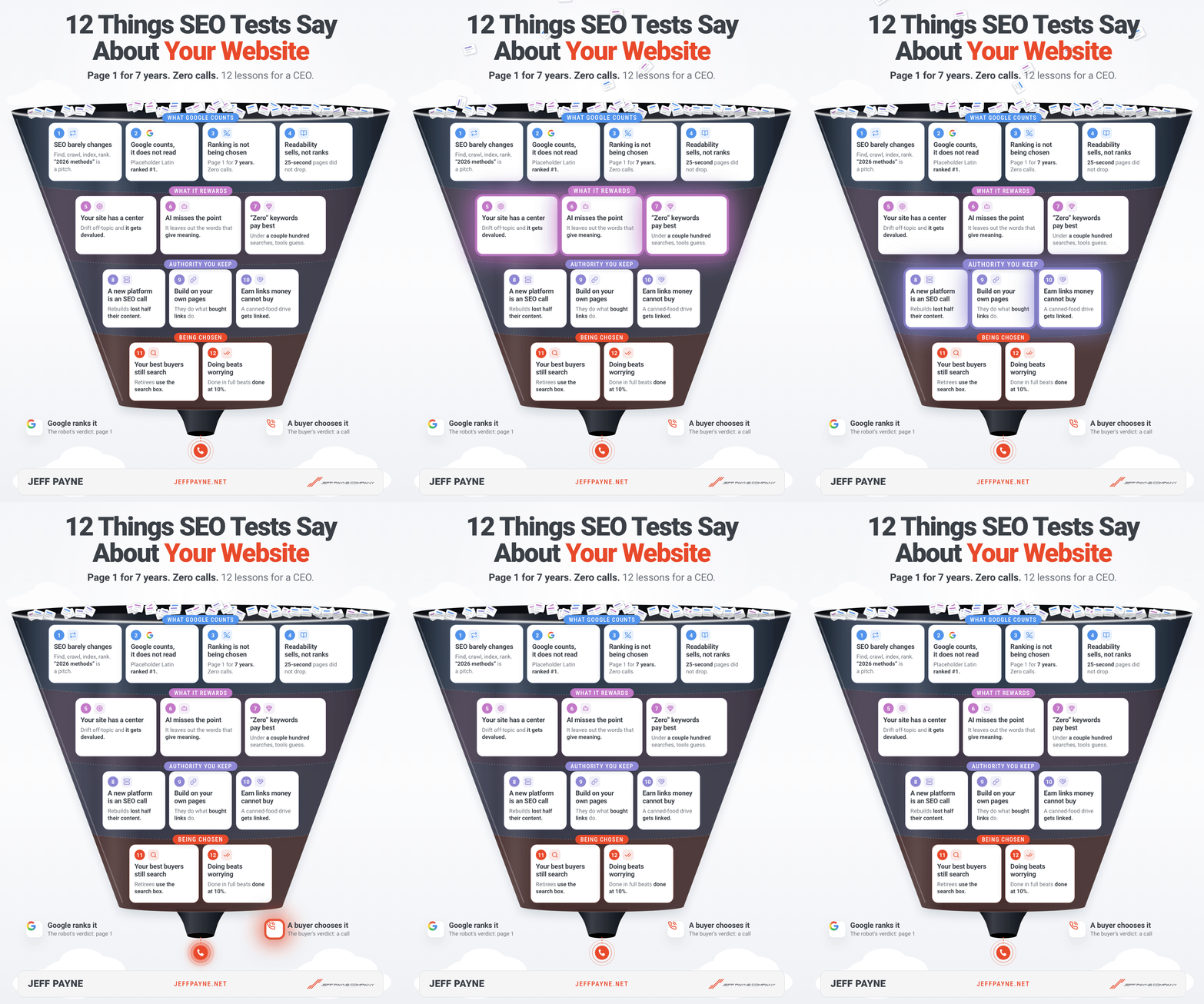
12 Things a Decade of Controlled SEO Tests Says About Your Website — and Why Most of It Is Good News for a CEO
The rhinoplasty page is the most famous result of a decade of controlled testing against Google, but it is far from the only one. Twelve more, translated from practitioner findings into what they mean for the person who signs the checks.


For every dollar we spend with you we are putting at least 5 back into our pocket AFTER we subtract what we spent.
That’s an amazing cost/benefit that I have never received before in any of our previous marketing endeavors.
Daniel C Goodwin
Provident 1031
Chief Investment Strategist
July 4, 2025
Three questions for the drive
Which report tells you whether a page is winning: the one about rankings or the one about revenue?
If Google can’t read your site, who exactly is the writing for?
I removed every form off your best-ranked page and replaced it with filler; how long would it take before you noticed?
Worrying about SEO and doing SEO are two different things.
Source: Kyle Roof, interviewed by Edward Sturm on The Edward Show, episode 1,213 (November 2026). Rhinoplasty experiment results, the seven-year page-one claim, and the zero-conversion figure are Roof’s own account.
COMPLETE THE FORM TO
BOOK A STRATEGY CALL
"*" indicates required fields


COMPLETE THE FORM TO
BOOK A STRATEGY CALL
"*" indicates required fields
Subscribe and S—are – WE APPRECIATE YOUR SUPPORT


