Somewhere right now, a CEO is asking ChatGPT about their own company. And the answer it gives isn’t built from their website. It’s built from a Reddit thread that three people wrote two years ago, which the CEO has never seen, will never see, and does not control.
That’s not a hypothetical. That’s the most common pattern in AI answers about businesses today. And most executives have no idea it’s happening.
Hi, I’m Jeff Payne. You’re listening to The Jeff Payne Show, Episode #57: The Authority You Don’t Own.
A few episodes back on this show, we talked about the difference between being cited and being the answer — and before that, why proprietary data and original research are two of the strongest levers you have for building AI authority. Those are things you can build. You own the page, you own the data, you own the timeline.
Today is the opposite conversation.
My go-to analyst, Kevin Indig of Memo-Growth, ran an analysis of roughly 35,000 ChatGPT citations tied to business-software buying decisions — every stage, from someone just starting to look to someone comparing two finalists. He stripped out the vendors’ own websites and asked one question: outside of what a company controls, what’s actually showing up in the answer?
Most companies split their outside-authority budget in two ways. Digital PR aims to get written up by publications. Review campaigns are aimed at getting rated on review sites. Both are real, both work, both are things you can plan a quarter around.
Here’s the number that should stop you: the largest outside source in these AI answers isn’t publications or review sites. It’s user-generated content — Reddit threads, Wikipedia entries, LinkedIn posts. Regular people talking, not campaigns running. And it holds more than four times the share that publications do.
That’s the whole budget conversation, upside down. The category getting the least deliberate investment is the one showing up the most.
Here’s where it gets more interesting than “invest in Reddit.”
Review sites behave exactly like you’d expect from a paid, planned channel. Their share nearly doubles right at the comparison stage — buyers building a shortlist — then falls back once someone’s down to two finalists. That’s a lever with a season. You can schedule a campaign against it.
Community content doesn’t do that. It barely moves — same tight band from the top of the funnel to the bottom. It’s not a lever you pull at the right moment. It’s a floor that’s just always there, whether you’re paying attention to it or not.
And inside that floor, three platforms account for basically all of it — Wikipedia, Reddit, and LinkedIn. Wikipedia alone is the single largest of the three at nearly every stage. Not run by any marketing department. Not biddable. Not a campaign you can greenlight in a meeting.
So what do you actually do with a source you can’t buy, schedule, or own?
You stop treating it like a campaign and start treating it like infrastructure. Digital PR has a start and end date. This doesn’t. The businesses showing up well here aren’t the ones who ran a sprint — they’re the ones who’ve been a real, honest presence in the places their buyers already talk, long enough for it to compound without anyone announcing it.
This is also the fastest way to spot a business that’s overconfident about its AI visibility. If your entire authority strategy is a press push and a review campaign, you’ve built for two of the four buckets and left the biggest one — the one running quietly in the background right now — completely unmanaged.
So ask yourself honestly: if someone typed your category into ChatGPT today, whose words would answer for you? Yours — or a stranger’s — from a thread you’ve never read?
That’s it for today’s episode. Thank you for listening. I’ll see you next time.
The biggest source shaping AI’s answers about your business isn’t your website. Here I will break down why community content is a floor you can’t buy — and what that means for your authority budget.
THE AUTHORITY YOU DON’T OWN
Somewhere right now, a CEO or business owner is asking ChatGPT about their own company — and the answer isn’t built from their website. It’s built from a Reddit thread they’ve never seen, on a platform they don’t control.
The largest outside source in AI answers isn’t publications or review sites. It’s regular people talking.
Where the authority budget actually goes
Most companies split their outside-authority spend in two ways: digital PR aimed at publications and review campaigns aimed at review platforms. Both are real levers and schedulable — you can plan a quarter around either one.
A recent analysis of roughly 35,000 ChatGPT citations tied to software-buying decisions found something that inverts that budget logic entirely. Stripping out vendor domains, user-generated content — Reddit, Wikipedia, LinkedIn, and similar community platforms — holds 17.1% of cited domains, more than 4x publishers (4.0%).
A Lever VerSUS A FLOOR
Review platforms behave like a channel responding to a campaign: their citation share swings from 7.4% up toward 13.2%, peaking at the comparison stage of the buyer journey, then falling back once a buyer narrows to finalists.

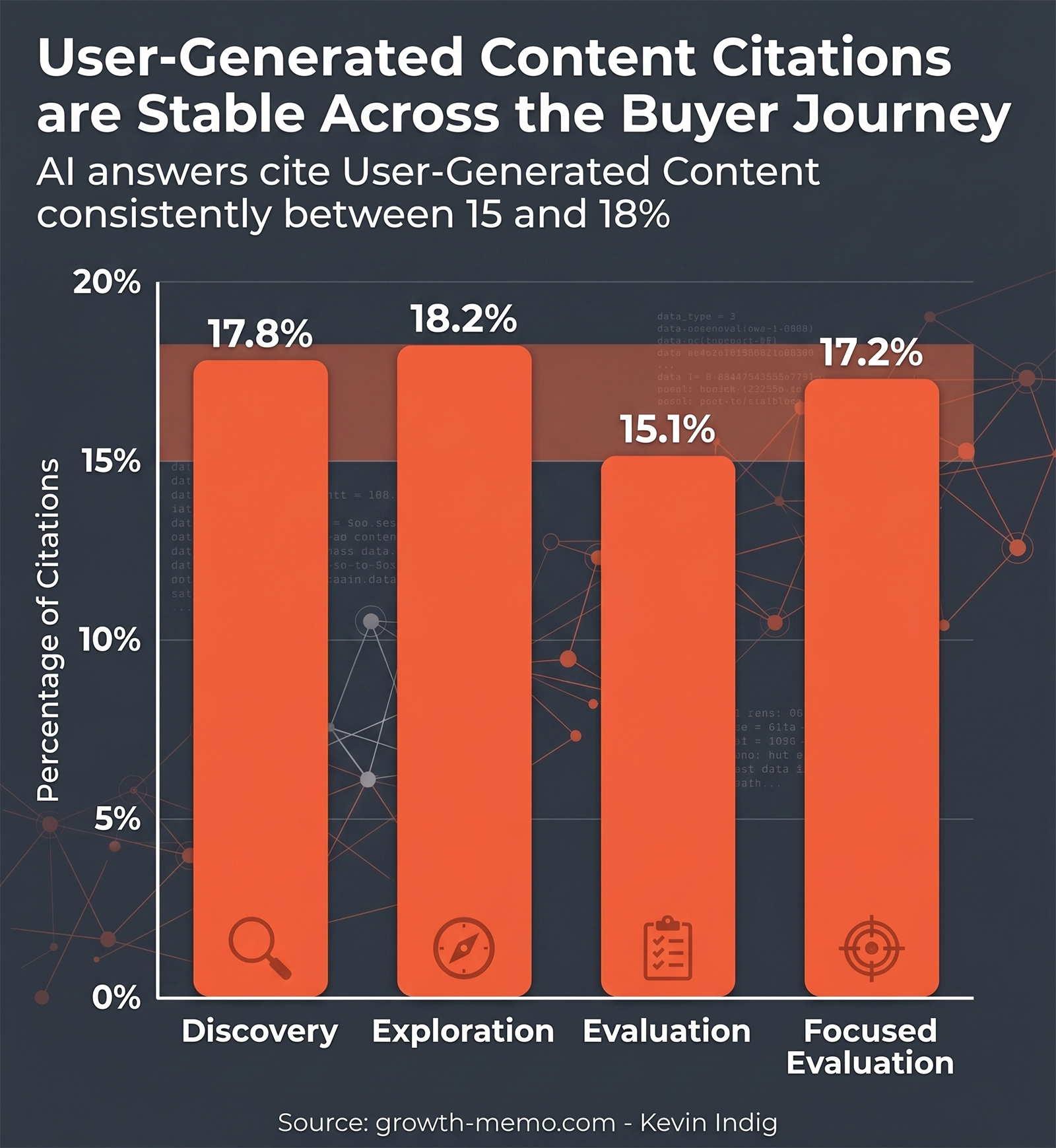
Community content doesn’t swing. Across the same journey, it holds in a tight 15.1%–18.2% band — a 3.1-point range, essentially flat. It isn’t a lever you pull at the right moment. It’s a floor that’s present at every stage, whether or not anyone at the company is managing it.

Review platforms are a lever you can schedule. Community presence is a floor that’s just always there.
Three platforms, almost no control
Inside that floor, concentration is extreme: Wikipedia, Reddit, and LinkedIn together account for ~99% of user-generated content citations. Wikipedia alone contributes 10.1–14.0 pts of the 17-pt floor — the single largest third-party source in the dataset at nearly every stage of the journey.

None of these platforms take a media buy. None of them respond to a press release. They reward sustained, honest presence — not a campaign with a start and end date.
Three platforms — Wikipedia, Reddit, LinkedIn — account for basically all of it. None of them are biddable.
What This Means For How You Allocate Authority
The practical takeaway isn’t a checklist of community tactics — it’s a budgeting correction. If your outside-authority strategy consists of a PR push and a review campaign, you’ve addressed two of the four buckets shaping how AI describes your business and left the largest one completely unmanaged.
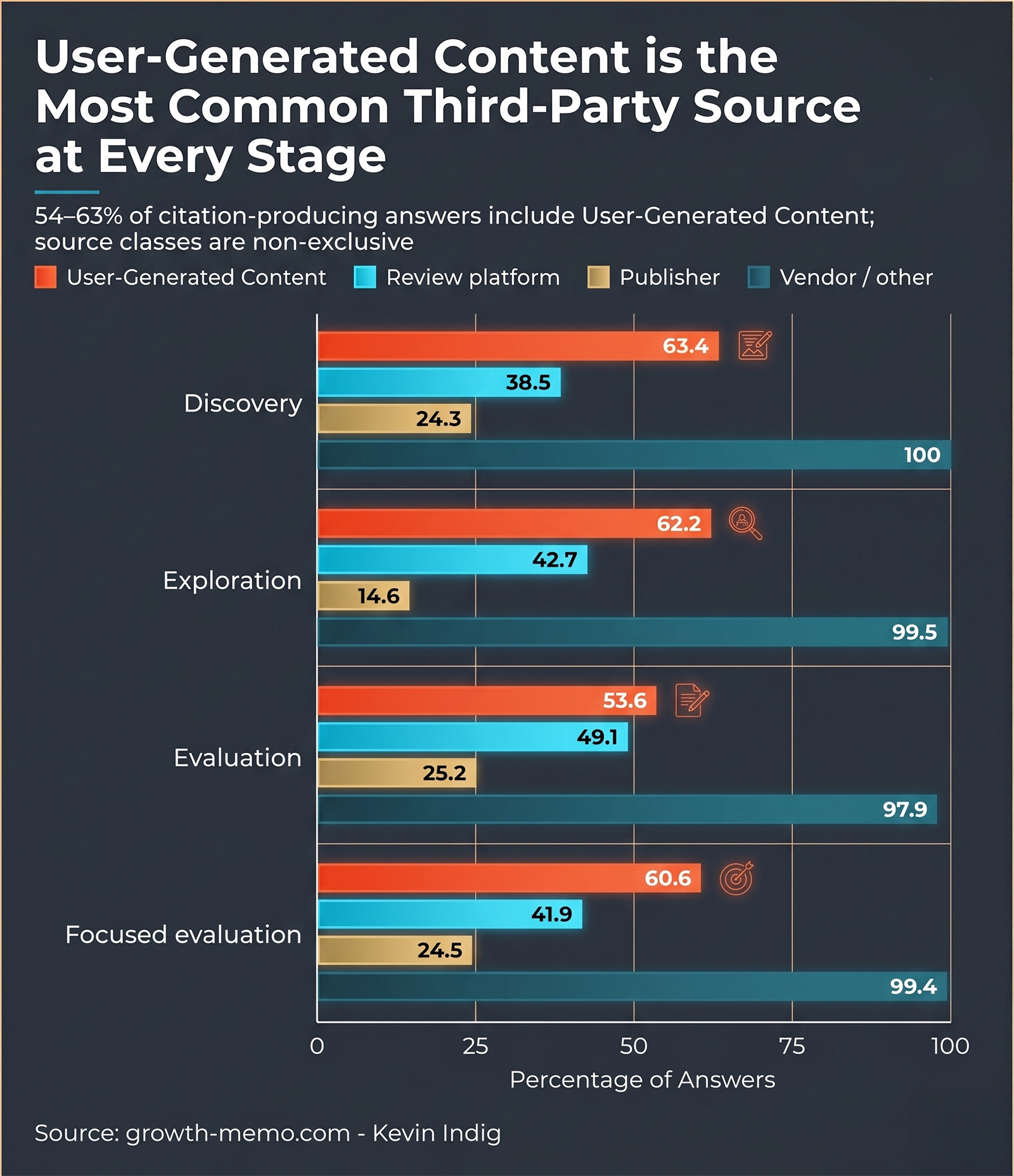
Community presence has to be funded and treated as a standing line item, not a campaign — because unlike PR or reviews, there’s no stage in the buyer journey where it’s safe to ignore.
If your authority strategy is a press push and a review campaign, the largest bucket remains unmanaged.
THE QUESTION WORTH ASKING
If someone typed your category into ChatGPT today, whose words would shape the answer about your business — yours, or a stranger’s, from a conversation you’ve never read?
A brand AI trusts at the bottom of a list still gets recommended over an unknown brand at the top.
Source: analysis by Kevin Indig and Amanda Johnson, Growth Memo — “How to grow your AI Visibility with community signals.” Part 4 of the Growth Memo brand-multiplication series: analysis based on ~35,000 ChatGPT citation URLs captured via Profound, US only, December 2025.
COMPLETE THE FORM TO
BOOK A STRATEGY CALL
"*" indicates required fields

COMPLETE THE FORM TO
BOOK A STRATEGY CALL
"*" indicates required fields
Subscribe and Share – WE APPRECIATE YOUR SUPPORT