
A COMPETITIVE ADVANTAGE
CONTENT RECENCY
This Article Is Human Authored
By Jeff Payne
Get an AI Summary of this post on:




Last week, a CEO called me with a problem that’s becoming increasingly common. His company had invested $50,000 in creating what they called “the definitive guide” to their industry back in 2021. It ranked #1 on Google for two years. Today? It’s invisible where it matters most—in AI-powered search results.
The uncomfortable truth is that the content strategy that worked for the last decade is rapidly becoming obsolete. And the data shows exactly why.
THE 74% REALITY CHECK
Seer Interactive recently dropped a study that should make every business owner rethink their content strategy. They found that AI Overviews—Google’s AI-powered search results—cite content published within the last two years 74% of the time. Perplexity shows similar bias at 70%. Even ChatGPT, which you’d think would favor comprehensive evergreen content, pulls from recent sources 60% of the time.
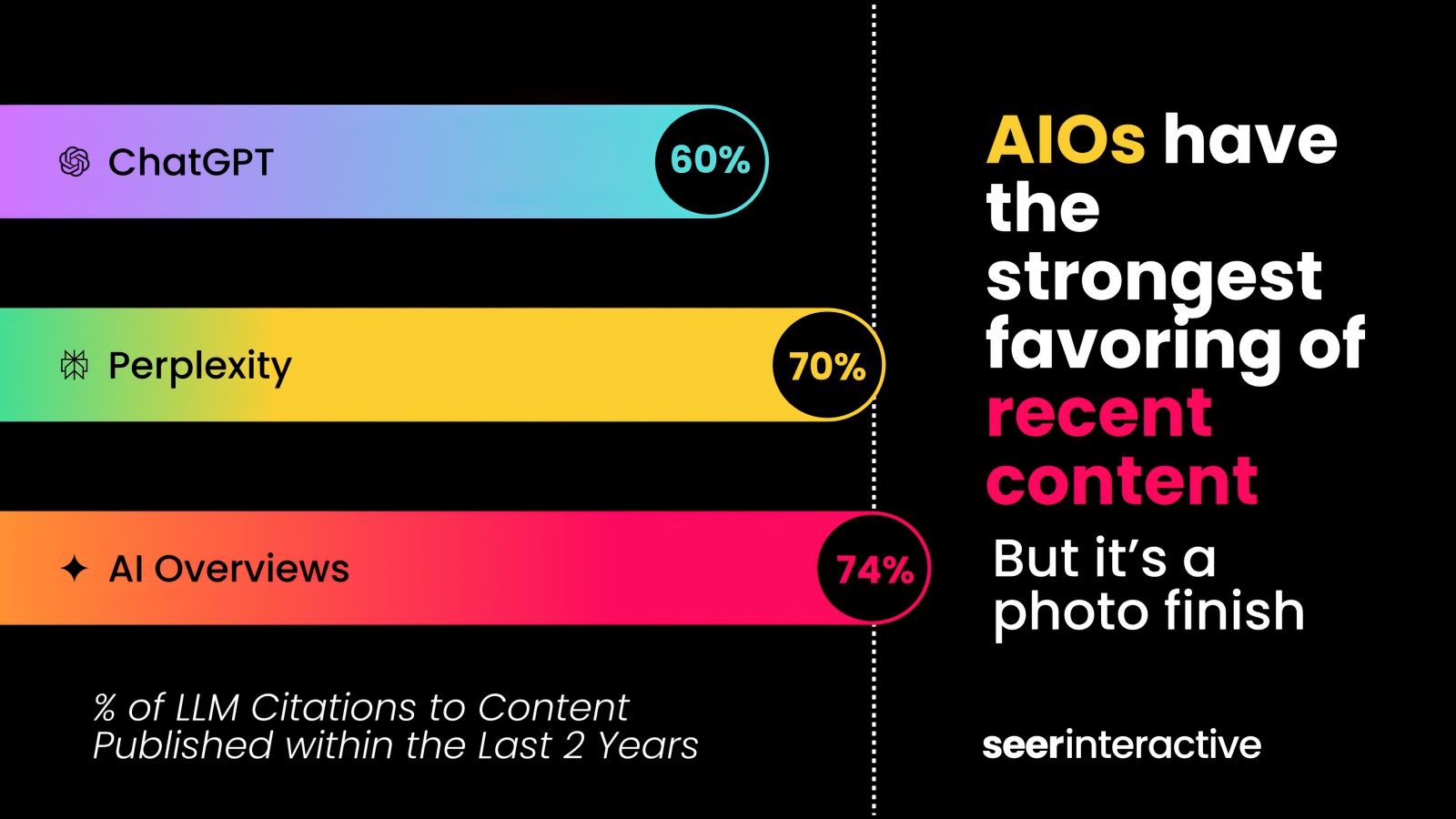
Think about what this means for your business. That cornerstone content you created in 2020? It has roughly a 26% chance of being cited by AI Overviews, even if it’s still ranking well in traditional search results. Your competitors publishing fresh insights this month? They’re playing with nearly triple the odds in their favor.
This isn’t a bug in the system—it’s the new feature. AI systems are designed to prioritize freshness because they’re trying to answer questions the way a well-informed human would. And well-informed humans don’t cite outdated information when current perspectives are available.
the death of
“set it and forget it” content
Here’s what most businesses still don’t understand: we’re not just witnessing another Google algorithm update. We’re watching the complete transformation of how information discovery works.
Traditional SEO taught us to build authoritative pages and maintain them. Update them once a year, maybe twice if you’re ambitious. The goal was simple: get the click. Once you ranked, you could coast on that authority for years.
But AI doesn’t browse websites—it extracts knowledge. And when it’s choosing between your three-year-old “complete guide” and your competitor’s analysis published last Tuesday, recency wins. Not sometimes. Most of the time.
Kevin Indig at Growth Memo frames this shift perfectly: we need to budget SEO for capacity, not just output. It’s not about creating more content—it’s about maintaining a continuous pipeline of fresh insights that keep your brand in the AI conversation.

WHY FRESH CONTENT BECAME AI’S PREFERENCE
The reason AI systems favor recent content isn’t arbitrary. Consider what these models are trying to accomplish. When someone asks ChatGPT or Perplexity a question, the AI is attempting to provide the most relevant, accurate, and current information available.
In a world where industries transform quarterly, regulations change monthly, and best practices evolve weekly, citing a source from 2021 feels like referencing a newspaper from another era. The AI isn’t just being trendy—it’s being practical.
“Your 10,000-word ultimate guide might rank #1 in search results but never appear in an AI Overview because fresher, more focused content exists on the topic.”
This creates an interesting paradox for businesses. The very content that Google’s traditional algorithm rewards for being “comprehensive and authoritative” might be precisely what AI systems skip over for being stale. Your 10,000-word ultimate guide might rank #1 in search results but never appear in an AI Overview because fresher, more focused content exists on the topic.


For every dollar we spend with you we are putting at least 5 back into our pocket AFTER we subtract what we spent.
That’s an amazing cost/benefit that I have never received before in any of our previous marketing endeavors.
Daniel C Goodwin
Provident 1031
Chief Investment Strategist
July 4, 2025
5 SCENARIOS
THAT ACTUALLY MATTER NOW
After analyzing dozens of client campaigns and studying how AI systems select sources, I’ve identified five strategic scenarios every business needs to address. These aren’t optional anymore—they’re table stakes for remaining visible in AI-driven discovery.

1. CREATE INFLUENCE BEYOND YOUR DOMAIN
COMPLETE THE FORM TO
BOOK A STRATEGY CALL
"*" indicates required fields
2. TECHNICAL EXCELLENCE THAT SPEAKS AI LANGUAGE
This isn’t about page speed anymore (though that still matters). It’s about making your content extractable and understandable by AI systems. Structured data, clear hierarchies, and semantic markup have evolved from “nice to have” to “invisible without.”
Think of technical SEO as building wheelchair ramps for AI. Without them, even your best content remains inaccessible. The businesses winning at AI visibility aren’t just publishing content—they’re packaging it in ways that make extraction effortless.
3. CONTENT VELOCITY THAT MATCHES MARKET SPEED
Here’s where the rubber meets the road. Content strength now requires three components working in harmony:
A client recently asked me why their comprehensive pricing guide from 2022 stopped generating leads. The answer is simple: three competitors had published pricing updates in the last quarter, each reflecting new market realities. Their static guide, despite being thorough, had become a museum piece.
We implemented a quarterly refresh cycle, not just updating numbers but adding new sections on emerging trends, addressing recent customer questions, and incorporating fresh case studies. The result? Their content started appearing in AI responses again, and lead quality improved because the information was current.
“Once AI grants you visibility through citation, you have seconds to prove value.”
4. FOUNDATIONAL RESEARCH THAT FEEDS UNIQUE DATA
Additive content has become the gold standard. This isn’t about reformulating existing information—it’s about contributing net-new insights to the conversation. AI systems are increasingly sophisticated at detecting originality, and they reward it accordingly.
Consider what makes content truly additive:
A B2B software company we work with stopped writing “how-to” content entirely. Instead, they publish monthly analysis of their user data, revealing trends their customers can’t see individually. This foundational research approach has made them the primary source AI systems cite for industry statistics.
5. ENGAGEMENT ARCHITECTURES THAT CONVERT VISIBILITY
Once AI grants you visibility through citation, you have seconds to prove value. This is where engineering, design, and interactive experiences become crucial. The validation click is just the beginning—what happens next determines whether you build trust or lose credibility.
We’re seeing successful brands invest in:
“A well-designed infographic or chart isn’t just supporting content anymore—it’s becoming primary source material.”
THE NEW ECONOMICS OF CONTENT INVESTMENT
This shift fundamentally changes how businesses should allocate marketing budgets. The old model was simple: invest heavily upfront in comprehensive content, then maintain minimally. The new model requires sustained investment in continuous content operations.
Let me put this in perspective. One client recently asked whether they should spend $30,000 on one comprehensive industry report or spread that investment across quarterly updates. Two years ago, I would have recommended the comprehensive report. Today? The quarterly approach wins every time.
Why? Because four quarterly reports give you four opportunities to be recent, four chances to incorporate emerging trends, and four moments where your content is “fresh” by AI standards. The comprehensive report, no matter how thorough, starts aging the moment it’s published.
BUILDING YOUR CONTENT
RECENCY ENGINE
Creating a sustainable content recency strategy doesn’t mean abandoning everything you’ve built. It means evolving your approach to match how information discovery now works.
Here’s how to start:
ESTABLISH REFRESH RHYTHMS
Different content types need different refresh cycles:
CREATE ADDITION OPPORTUNITIES
Every piece of existing content should have a roadmap for additions. This isn’t about rewriting—it’s about layering new insights, recent examples, and emerging perspectives onto solid foundations.
DEVELOP INFORMATION GAINS HABITS
Train your team to constantly ask: “What can we add to this conversation that doesn’t exist elsewhere?”
This might be:
THE UNCOMFORTABLE TRUTH
ABOUT YOUR COMPETITION
While you’re reading this, your competitors are either ignoring this shift or actively adapting to it. There’s no middle ground. The businesses that recognize content recency as a competitive advantage are already restructuring their content operations.
A competitor analysis we recently conducted revealed something striking: in a field of 12 major players, only two had content less than six months old on their main service pages. The other ten were competing for traditional SEO rankings with content averaging 2.5 years old.
Guess which two appeared most frequently in AI Overviews?
This creates an unusual opportunity. Most businesses are still operating under old assumptions. They’re optimizing for algorithms that are rapidly becoming secondary. By moving quickly to embrace content recency, you can leapfrog established players who are slow to adapt.


This is one of the best written, most informative email newsletters I’ve ever read!
Thank you for sharing your expertise, and hope you’re doing well.
Beth Zimmerman
Founder, Executive Director

THE INTEGRATION CHALLENGE
The hardest part isn’t creating fresh content—it’s integrating content recency into existing operations. This requires coordination across multiple teams and a fundamental shift in how content is valued.
Marketing can’t operate in isolation anymore.
You need:
One client described it perfectly: “We had to stop thinking about content as projects and start thinking about it as a continuous broadcast.” In other words, every business is a publisher — or if they do not adapt to the new reality, they will soon be relegated to irrelevance.
“Every business is a publisher — or if they do not adapt to the new reality, they will soon be relegated to irrelevance.”
THE SETH GODIN PRINCIPLE
IN AI DISCOVERY
Seth Godin’s “Permission Marketing” concept has found new relevance in AI-mediated discovery. These systems are learning user preferences, building behavioral profiles, and essentially becoming the filter between businesses and their audiences.
When someone consistently turns to ChatGPT or Perplexity for industry insights, these systems learn what sources that user trusts, what depth they prefer, and what perspectives resonate. Fresh content gives you more opportunities to be part of that learning process.
Think about it: every time your recent content gets cited and a user engages positively with it, you’re training AI systems to see you as a valuable source. But this permission is perishable. Stop publishing fresh insights, and you quickly get replaced by more active voices.
THE recency imperative
The businesses that will thrive in AI-mediated discovery aren’t necessarily those with the most content or the biggest budgets. They’re the ones that recognize information freshness as a strategic asset and build operations to sustain it.
Your three-year-old ultimate guide might still rank #1 on Google today. But in a world where 74% of AI citations go to recent content, that ranking becomes increasingly meaningless. The real question isn’t whether you need fresh content—it’s whether you can afford to let your competitors be more recent than you.
The shift from “get the click” to “get the citation” isn’t coming. It’s here. And content recency isn’t just an optimization tactic anymore—it’s your competitive advantage.
The only question left is whether you’ll use it.
COMPLETE THE FORM TO
BOOK A STRATEGY CALL
"*" indicates required fields