Picture a dentist. A patient comes in needing a root canal, but she doesn’t perform root canals, so the dentist refers the patient to an endodontist two blocks away. The Endodontist has a good practice, a good reputation, and the dentist has sent people there for years.
Six weeks later, the patient’s back in the dentist’s chair. The first thing out of her mouth isn’t about the endodontist. It’s: “Why did you send me there?”
The dentist didn’t do the work. She made the recommendation. And the recommendation is what she’s answering for.
Now flip that around.
Every link on the internet pointing to your business is someone making that exact call about you. And every link you give is you making it about them.
Most owners have never looked at either list.
Hi, I’m Jeff Payne. You’re listening to The Jeff Payne Show, Episode #97: The Link Is a Referral.
If you own a business, you’ve heard the term backlinks. Your marketing person wants more of them. Someone’s quoted you a number. And you’ve probably pictured it as plumbing — pipes moving invisible authority from one website to another.
Strip away the jargon, and here’s what a link is. Another business, another organization, or someone in your town puts your name on their page and tells their people to go see you.
That’s a referral.
It’s the same thing that built your business before the internet existed — the plumber who recommends the electrician, the banker who recommends the CPA. Except now it’s written down, public, and Google reads every single one.
Once you see it that way, the whole backlink conversation changes. A referral has two halves, and most businesses are getting both of them wrong.
Half one: who’s making the recommendation?
Here’s the test. Would you want this link if Google shut down tomorrow?
A partner business down the street that sends you customers — that passes.
The chamber of commerce page, the youth league you sponsor, and the charity gala where your logo’s on the banner — those pass if anyone in that crowd ever walks through your door.
A link from a page nobody in your town will ever visit — that fails. Not because Google’s going to punish you for it, but because it was never a referral in the first place. It’s paperwork.
And Google is better than most people think at distinguishing between them.
Two episodes ago, I said Google ranks what gets picked, not what gets placed. A link people actually follow is picked. A link nobody follows is just placed.
Then there’s the other direction, and this is the part I’d want every owner to sit with. When you recommend another local business on your website — a partner, a vendor, or somebody you send work to — you are staking your name on where your customers end up. That’s the dentist and the endodontist. If it goes badly, they don’t blame the endodontist.
They blame you for the referral. So vet the businesses you link to the way you’d vet somebody you’d send your own mother to.
Half two: what the recommendation says.
Most of the time, the clickable text on a link is just your business name. You can’t control that, and you shouldn’t try. But there’s a sentence around that name — a description — and that sentence is doing more work than the link itself.
“Century Smile Dental” tells Google you exist. “Century Smile Dental, a family dentist in Culver City, CA” tells Google what you are and where you are. That’s the difference between being a name and being an answer.
And here’s the uncomfortable part. Those sentences are written by other people. The chamber. The sponsor page. The partner’s website. And most of them were copied from a form someone in your office filled out years ago.
That means the description of your business that Google trusts most — the one written by someone other than you — is probably one you’ve never read.
Let me give you a real one. Colt Melrose, a Houston headshot photographer in Houston.
Colt is not the most-reviewed headshot photographer in Houston. He’s not trying to be.
What Colt has is something better. Every time his name appears — in a client’s story, a mention, or a recommendation — it says the same three things.
What he does: business headshots.
Where he does it: Houston.
And what happened to the client afterward — his clients tell stories about a headshot that’s tied to more than a $1,000,000 in new business revenue.
Trade. Town. Outcome. Story. Every time.
And where did that land him? #1 on Google for “business headshots Houston.” Look at that search. It’s the trade and the town. It’s the exact phrase people had been writing about him, and it’s ranking.
He didn’t win that by volume. He won it because every time someone recommended him, they said the right thing.
So here’s what I’d do. It’s not a project. It’s an afternoon.
Find the last 10 places online that mention your business, not your site — theirs. The chamber, the sponsorships, the partners, the directories, the podcast you were on.
For each one, two questions.
Would a customer ever click this?
Does it say what I do and where I do it?
If you’re getting mostly no’s, you don’t have a link problem. You have a recommendation problem. The good news is that the people writing those recommendations are usually waiting for you to tell them what to say.
Three questions to take with you.
Who’s recommending you right now, in writing, in your town — and would you want them to if Google didn’t exist?
Who are you recommending — and would you put your name on the list where they send your customers?
And the sentence other people use to describe your business — have you ever read it?
Thank you for listening. I’m Jeff Payne. I’ll see you tomorrow.
Why the backlink conversation changes the moment you stop calling it a backlink
Picture a dentist. A patient needs a root canal, but she doesn’t perform them, so she sends the patient to an endodontist two blocks over — good practice, good reputation. She’s referred people there for years. Six weeks later, the patient is back in her chair, and the first thing the patient says isn’t about the endodontist. It’s: “Why did you send me there?”
She didn’t do the work. She made the recommendation. The recommendation is what she’s responsible for.
Every link on the internet pointing to your business is someone making that exact call about you. Every link you give is you making it about them. Most owners have never looked at either list — and that’s the whole point of this episode.
A backlink, with the jargon removed
If you own a business, you’ve heard the term backlinks. Your marketing person wants more of them, someone has quoted you a number, and you’ve probably pictured it as plumbing — pipes moving some invisible authority from one website to another.
Here’s what a link is once you take the jargon off. Another business, another organization, or someone in your town puts your name on their page and tells their people to go see you. That’s a referral. It’s the same mechanism that built your business before the internet existed — the plumber who recommends the electrician, the banker who recommends the CPA — except now it’s written down, public, and Google reads every one of them.
That reframe matters because a referral has two halves. Who makes it and what it says. Most businesses get both halves wrong, and most backlink advice aimed at owners never mentions either.
A link is a referral that is written down, public, and readable by Google.
Half one: who’s making the recommendation
The test is simple. Would you want this link if Google shut down tomorrow?
A partner business down the street that sends you customers passes. The chamber of commerce page, the youth league you sponsor, the charity gala with your logo on the banner — those pass if anyone in that crowd ever walks through your door. A link from a page nobody in your town will ever visit fails. Not because Google will punish you for it, but because it was never a referral in the first place. It’s paperwork.
Google is better than most people think at distinguishing between them. A couple of episodes ago, I made the case that Google ranks what gets picked, not what gets placed. A link people actually follow is picked. A link nobody follows is placed.
One is evidence of a real recommendation; the other is a line in a spreadsheet.
Then there’s the direction owners forget. When you recommend another local business on your own site — a partner, a vendor, or someone you send work to — you’re staking your name on where your customers end up. That’s the dentist and the endodontist. If it goes badly, they don’t blame the endodontist. They blame the referral. Vet the businesses you link to the way you’d vet someone you’d send your own mother to.
Would you want this link if Google were to shut down tomorrow? If not, it was never a referral. It’s paperwork.
Half two: what the recommendation says
Most of the time, the clickable text on a link is just your business name. You can’t control that, and you shouldn’t try. But there’s a sentence around that name — a description — and that sentence is doing more work than the link itself.
“Century Smile Dental” tells Google you exist. “Century Smile Dental, a family dentist in Culver City, CA” tells Google what you are and where you are. That’s the difference between being a name and being an answer. Local authority doesn’t live in the link. It lives in that sentence.
Here’s the uncomfortable part. Those sentences are written by other people — the chamber, the sponsor page, the partner’s website — and most of them copied wording from a form someone in your office filled out years ago. That means the description of your business that Google trusts most, the one written by someone other than you, is probably one you’ve never read.


This is one of the best written, most informative email newsletters I’ve ever read!
Thank you for sharing your expertise, and hope you’re doing well.
Beth Zimmerman
Founder, Executive Director

Trade. Town. Outcome. STORY.
Colt Melrose is a Houston headshot photographer and a longtime client. He isn’t the most-reviewed photographer in Houston, and he isn’t trying to be. What he has is better: every time his name appears anywhere — in a client’s story, a mention, or a recommendation — it says the same three things.
What he does: business headshots.
Where he does it: Houston.
And what happened to the client afterward: his clients tell stories about a headshot tied to more than $1,000,000 dollars in new business.
Where did that land him? #1 on Google for “business headshots Houston.” Look at that search.
It’s the trade and the town — the exact phrase people had been writing about him, which came back as a ranking.
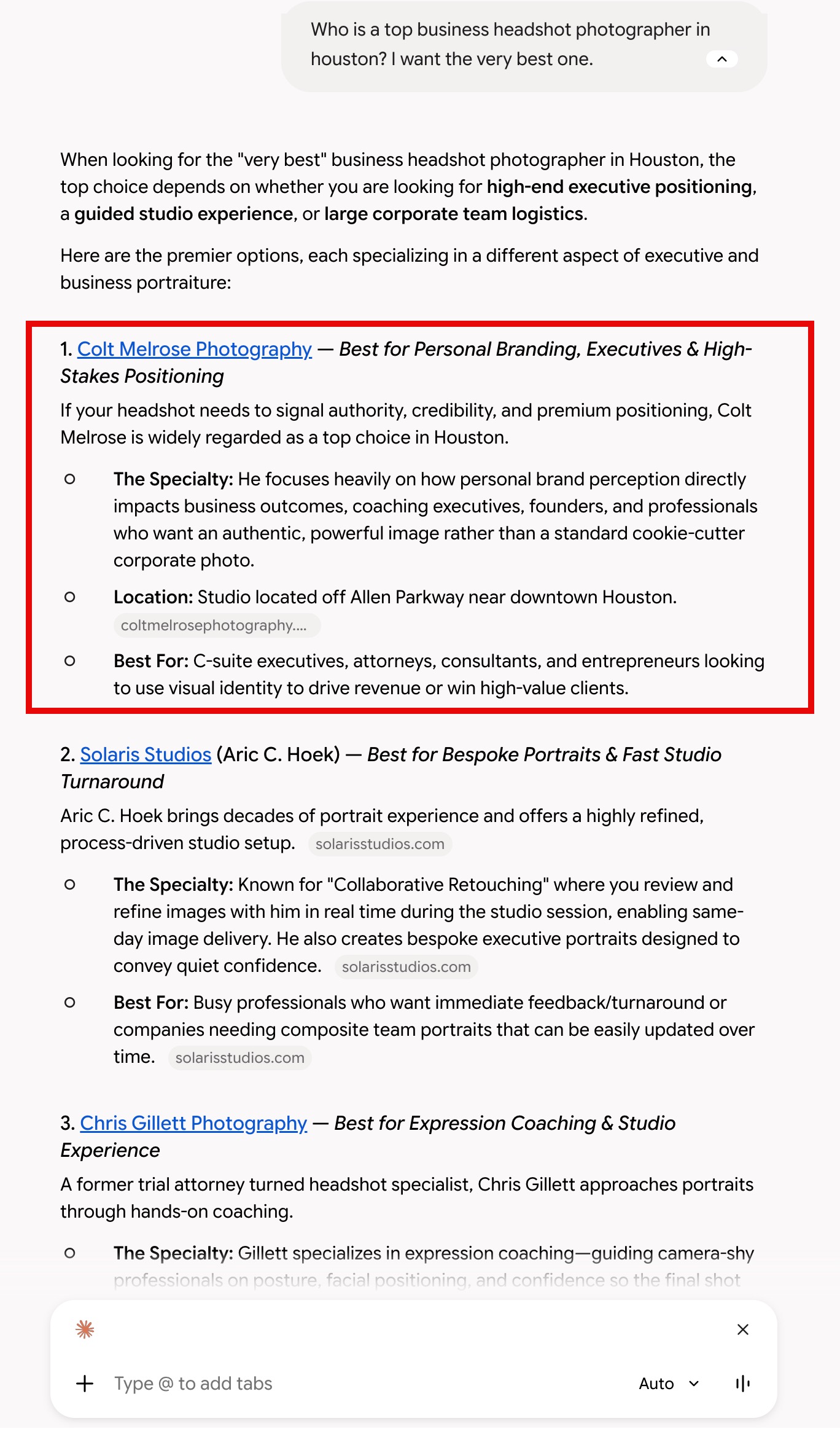
He didn’t win that by volume. He won it because every time someone recommended him, they said the right thing.
He didn’t win with volume. He won because every time somebody recommended him, they said the right sentence.
The move: an afternoon, not a project
Find the 10 most recent online mentions of your business. Not your site — theirs. The chamber, the sponsorships, the partners, the directories, the podcast you were on.
For each one, two questions.
Would a customer ever click this?
Does it say what I do and where I do it?
If you’re getting mostly no’s, you don’t have a link problem. You have a recommendation problem. The good news is that the people writing those recommendations are usually waiting for you to tell them what to say.
You don’t need more pages. You need the right ones.
Three questions
Frequently asked questions
Source: This episode was prompted by Edward Sturm’s The Edward Show, episode 936, on building local backlinks for local topical authority. The episode is an original work that reframes the general thesis for a business-owner audience; the examples, stories, and framing are Jeff’s own.
COMPLETE THE FORM TO
BOOK A STRATEGY CALL
"*" indicates required fields


COMPLETE THE FORM TO
BOOK A STRATEGY CALL
"*" indicates required fields
Subscribe and Share – WE APPRECIATE YOUR SUPPORT





