You don’t have an seo problem.
you have a listening problem.
A candle company ran keyword research one afternoon, not for any strategic reason, just poking around. They noticed a consistent stream of searches for mini candles. Small ones. Not the big jar candles that dominate the shelves. The little ones.
So they built a product page before they had a product in stock. Orders started coming in for a candle that didn’t exist yet.
That’s not a clever marketing trick. That’s the internet telling a business exactly what it wants, out loud, in real time, completely free — and almost no one is listening.
That’s the story that opens Episode 12 of my podcast. And it sets up the real conversation: what business owners consistently get wrong about SEO, and why the answer has almost nothing to do with technology.
The market doesn’t search the way you talk. It searches the way it thinks.
The Market doesn’t search
the way you talk
Here’s the mistake I see every week. A business owner builds their website, their service pages, their messaging — all of it constructed from the inside out. Their categories. Their language. Their industry vocabulary. Then they wonder why the phone isn’t ringing.
The market doesn’t search the way we talk. It searches the way it thinks.
A roofer doesn’t get found by “roof restoration services.” They get found by, “Why is my ceiling leaking after it rains?” A 1031 exchange specialist doesn’t get found by “1031 exchange consultant.” They get found by “how do I sell an investment property without paying capital gains?”
Keyword research isn’t an SEO chore. It’s market research. It’s real people typing their actual problems into a search bar with their wallets in the other hand. When you skip that step, you don’t have an SEO problem — you built the wrong thing for the wrong person using the wrong words.

I hear this constantly. And it’s almost never true. What’s actually true is that the research was too narrow. If you search your exact service name and find nothing, that’s not proof of no demand. That’s proof you searched the wrong phrase.
Keyword research isn’t an SEO chore. It’s market research — real people typing their actual problems into a search bar with their wallets in the other hand.
AI Changed the Game.
The Fundamentals Didn’t.
For twenty years, SEO meant ranking on the results page, getting a click, and hoping the visitor converted. That era is ending fast.
ChatGPT, Gemini, Perplexity, AI Overviews, Grok — these systems are skipping the click entirely. They read the web, synthesize what they find, and hand the user an answer. Sometimes with your name in it. Often without.
Here’s what most business owners haven’t figured out yet: the businesses getting named by AI aren’t winning because they have an “AI strategy.” They’re winning because they built real authority signals. Current, verifiable, third-party proof that other people and platforms are paying attention to them right now.
This week, a client of mine — Daniel Goodwin, founder of Provident 1031 — launched a book. In a single day, it hit number one on Amazon in three different categories: retirement planning, real estate investments in Kindle, and real estate investments in print. Three bestseller badges in twenty-four hours.

The book sales matter. But here’s what matters more: that’s a signal. It’s the internet’s version of a crowd suddenly turning to look at someone. Search engines see that activity. AI systems crawl it. And when those systems are deciding whether to recommend someone as credible, that kind of concentrated, third-party validation tips the scale.
Compare that to the alternative — which is what most businesses are operating with right now. A static bio. A stock photo. A service page that reads almost identically to every competitor in the category. There’s nothing there for Google or AI to latch onto and say, “This is the one. This is relevant right now.”
Sameness doesn’t get cited. Authority does.
Sameness doesn’t get cited. Authority does.
What a real foundation actually looks like
If you run a service business with three or four distinct services, you need three or four distinct pages — not one page that vaguely gestures at all of them. Each service has its own search intent, its own questions, its own buyer conversation. When you pile everything together, you’re signaling to search engines and AI that you don’t have depth on any of it. And depth is exactly what gets you cited.
But most businesses stop at the page itself. Two things are missing almost every time.
The first is customer stories — not testimonials. A testimonial is a sentence someone said about you. A story is what actually happened: the situation, the problem, the result. One client, Colt Melrose of Colt Melrose Photography in Houston, has dedicated story pages for individual clients — Kim Moore, the Lin Law Firm, Greg Phillips, Meredith Page — each one with its own URL, its own context, its own proof. A potential client searching for their version of the problem can land on a page and recognize themselves in it. Search engines read that specificity as credibility.
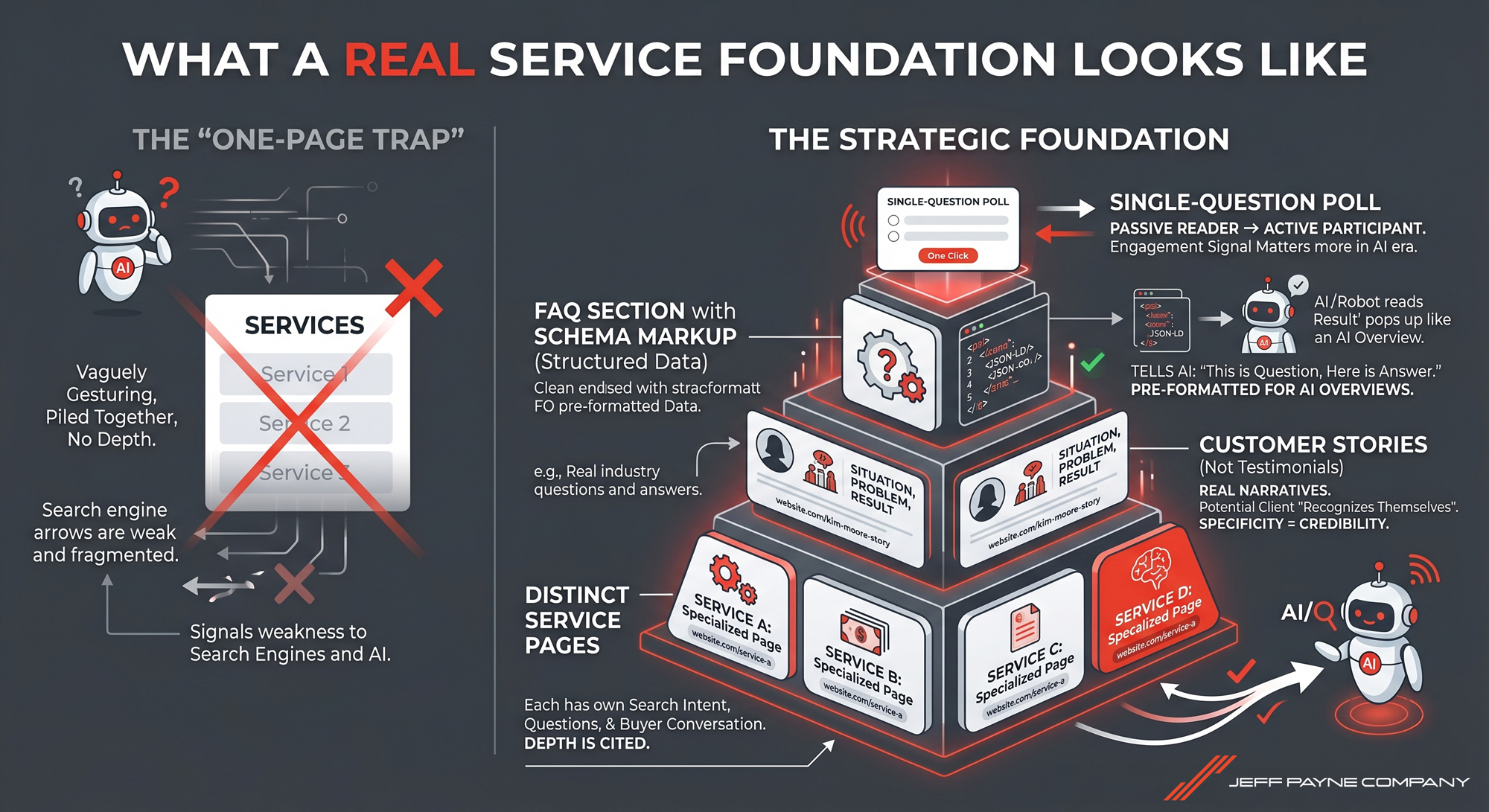
The second missing piece is an FAQ section with schema markup. You’ve seen AI Overviews pull a clean answer to the top of a search result. A significant portion of those answers come from FAQ sections tagged with structured data — code that tells Google: “This is a question, and here is the answer.” When built correctly, you’re handing AI a pre-formatted response and saying, “Use this.” They do.
Another client, Burbank Dental Lab, built product pages with up to ten FAQs each — real questions dental professionals ask about fabrication, indications, and adjustment procedures — structured and answered precisely. When a dental professional searches “why do patients stop wearing night guards,” that page is positioned to be the answer. Not a ranking hope. An actual answer, handed directly to AI.
And on that same page, there’s something else worth noting: a single-question poll. No name required, no email required. One click. It converts a passive reader into an active participant — and in an era where AI is answering more questions before anyone reaches a website, that additional engagement signal matters more than most businesses realize.
Navigation gives your site a skeleton. Contextual links give it a nervous system. Most sites only have one.
The Part Nobody Talks About
Here’s what nobody tells you about building this correctly: it doesn’t feel dramatic while it’s happening.
You build out a service page around what people are actually searching for. You add the proof. You write the story. You structure the FAQ. You build contextual links — not just navigation links, but links embedded inside your content that connect related ideas at the moment they become relevant. Navigation gives your site a skeleton. Contextual links give it a nervous system. Most sites only have one.
You do all of that and nothing happens for a while. Then one day, you’re showing up in a result you never tried to rank for. Someone tells you ChatGPT recommended them to you. And you never once touched anything called an “AI strategy.”
That’s not luck. That’s compounding — the kind that builds slowly, quietly, and then all at once.
It also works in the other direction. Every month you delay building that foundation, a competitor is building theirs. The gap doesn’t stay the same. It widens.
It doesn’t feel dramatic while it’s happening. Then one day, everything changes.
The Right Question To Ask First
Before you ask how to get found by ChatGPT, ask a simpler question.
If a stranger typed their actual problem into Google right now — in their words, not yours — would they find you?
If the honest answer is no, that’s not an AI problem. It’s not really even an SEO problem. It’s a “we built this for ourselves, not for the people looking for us” problem.
Fix that, and everything downstream — the rankings, the AI citations, the leads — starts to take care of itself.
COMPLETE THE FORM TO
BOOK A STRATEGY CALL
"*" indicates required fields
CHAPTERS:

COMPLETE THE FORM TO
BOOK A STRATEGY CALL
"*" indicates required fields
Subscribe and Share – WE APPRECIATE YOUR SUPPORT