You’ve been investing in authority. You’re publishing content, earning mentions, and building your brand’s presence online. So why is AI still pointing people to everyone but you?
Why ai RECOMMENDS your competitors
There’s a specific frustration that’s showing up in boardrooms and strategy sessions right now, and it sounds something like this:
“We’ve been doing everything right. We have a great website. We’re publishing content. We’ve been mentioned in reputable outlets. We invested in SEO. So why does AI keep recommending our competitors instead of us?”
It’s a fair question. And the answer is one that most marketing agencies aren’t telling you — because it changes the entire game plan.y.
The issue isn’t how much authority you’ve built. It’s where you built it.
The DISCOVERY
Kevin Indig and Amanda Johnson, two of the sharper analysts in the AI search space, published research this week that makes something concrete that most people have only suspected. They analyzed a real dataset of AI citations across multiple business topics and found that AI doesn’t use one universal source list to answer questions.
It rebuilds its trusted source set for every topic it’s asked about.
Ask AI about invoicing, and it reaches for one specific set of sources. Ask it about starting a business, and it reaches for a largely different set. Same AI model. Same intelligence. Completely different sources depending on what’s being asked.
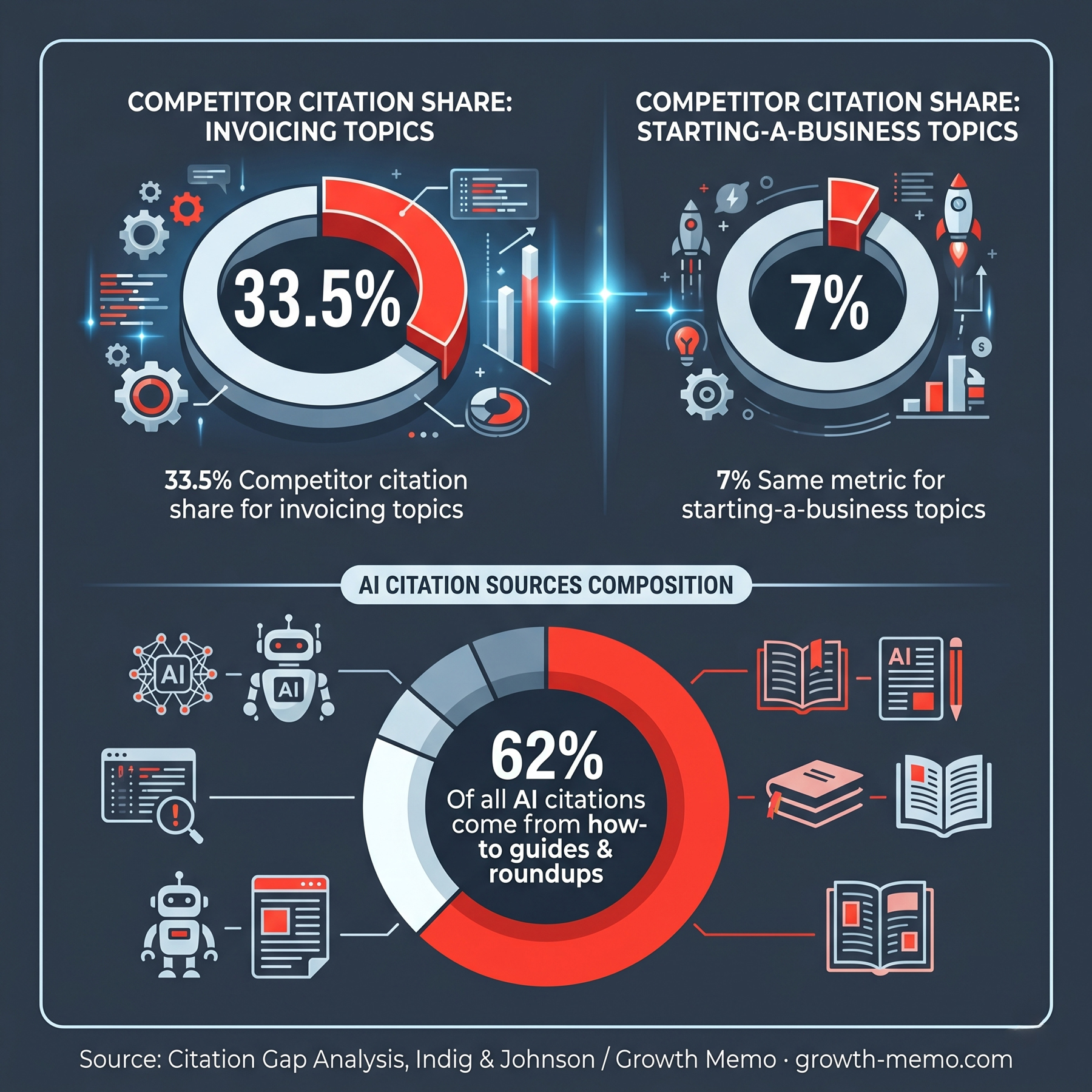
Their data puts a number on this: competitor domains made up 33.5% of what AI cited in invoicing-related questions, but only 7% in starting-a-business questions. That’s not a minor variation. That’s a near-complete flip in who AI considers credible based on the topic.
WHAT THIS MEANS FOR YOUR BUSINESS
Here’s what makes this genuinely important for business owners and not just for marketing teams to worry about:
Most authority-building investment is still being made the old way. Get featured in high-traffic publications. Earn backlinks from respected sites. Build your domain’s general reputation. And while that’s not wrong, it misses something critical that AI has changed the way trust actually works.
AI doesn’t form a fresh opinion about your brand every time someone asks it a question. It borrows trust from sources it already associates with a given topic.
Your website is an input. A useful one. But probably the weakest one in the mix. The publications, the analysts, the recognized experts, the communities that are already trusted in your specific domain — those are what carry real weight when AI decides who to point people to.
This explains something that puzzles many business owners: two companies can have nearly identical websites, identical content quality, and identical SEO optimization — and one is consistently cited by AI while the other is completely invisible. It’s not what’s on their website that’s different. It’s where their off-property reputation has been built.
This isn’t a content problem. It’s a reputation problem — and those two things have very different solutions.
AUTHORITY DOESN’T PAY EVENLY.
There’s a second piece of this research that deserves attention, because it changes how you should think about prioritization.
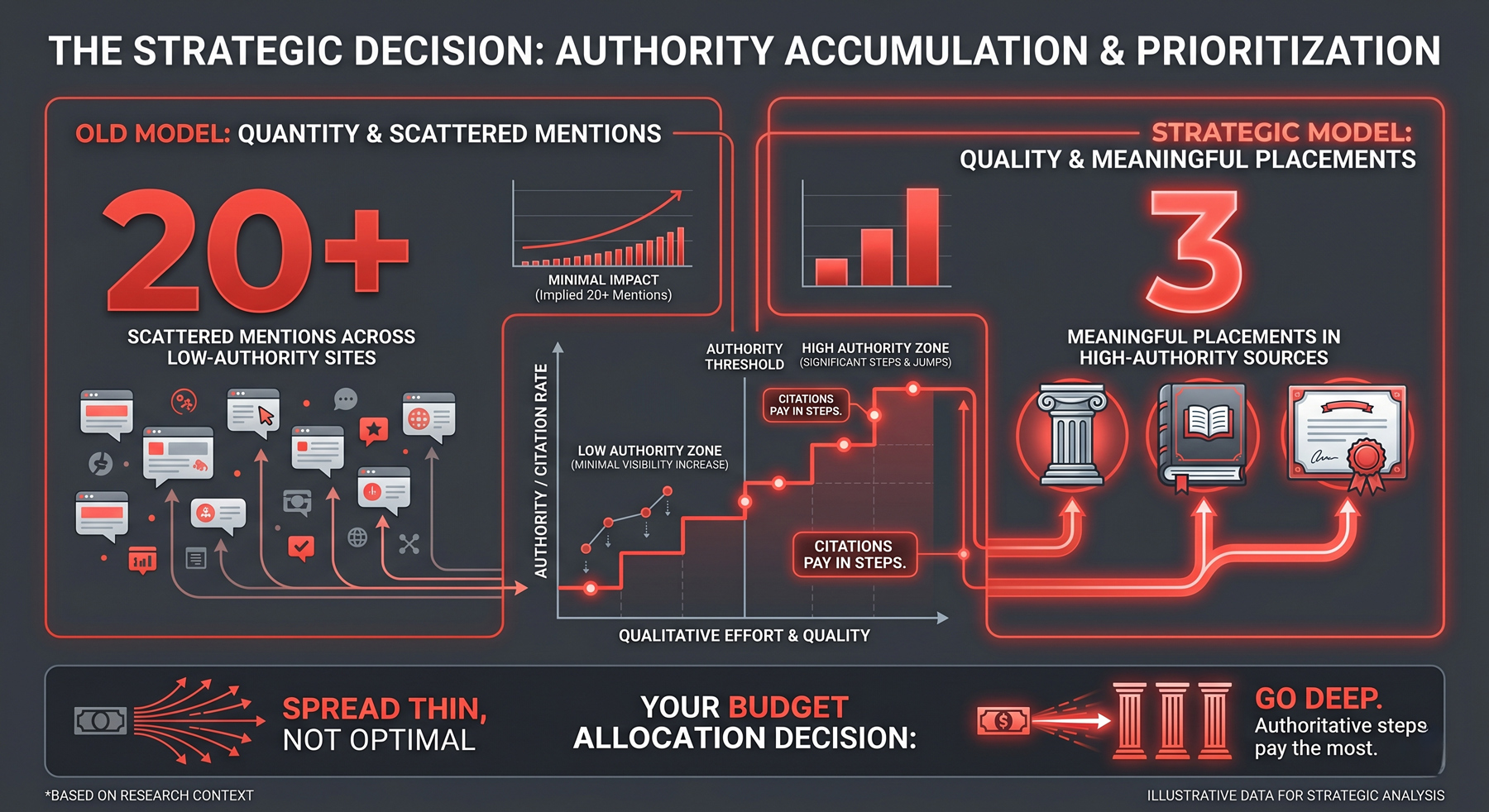
Indig and Johnson’s analysis of over a thousand domains showed that authority doesn’t accumulate in a straight line. It pays in steps. Getting a bit more visibility in a mid-tier source probably won’t change how often AI cites you. The citation rate doesn’t meaningfully improve until you achieve top-tier presence in sources that are already recognized as authoritative for your specific topic.
In practice: three meaningful placements in a high-authority source within your topic space will move you further than twenty scattered mentions across low-authority sites.
That’s a different budget allocation decision than most businesses are making right now. Most are spreading thin. The research suggests the move is to go deep.
THE FORMAT QUESTION NOBODY ASKS
One more finding worth sitting with: of over 56,000 cited source rows in their analysis, how-to guides and roundups together accounted for 62% of what AI actually cites. Not long-form essays. Not executive thought leadership. Guides and roundups — content structured to answer a specific question directly.
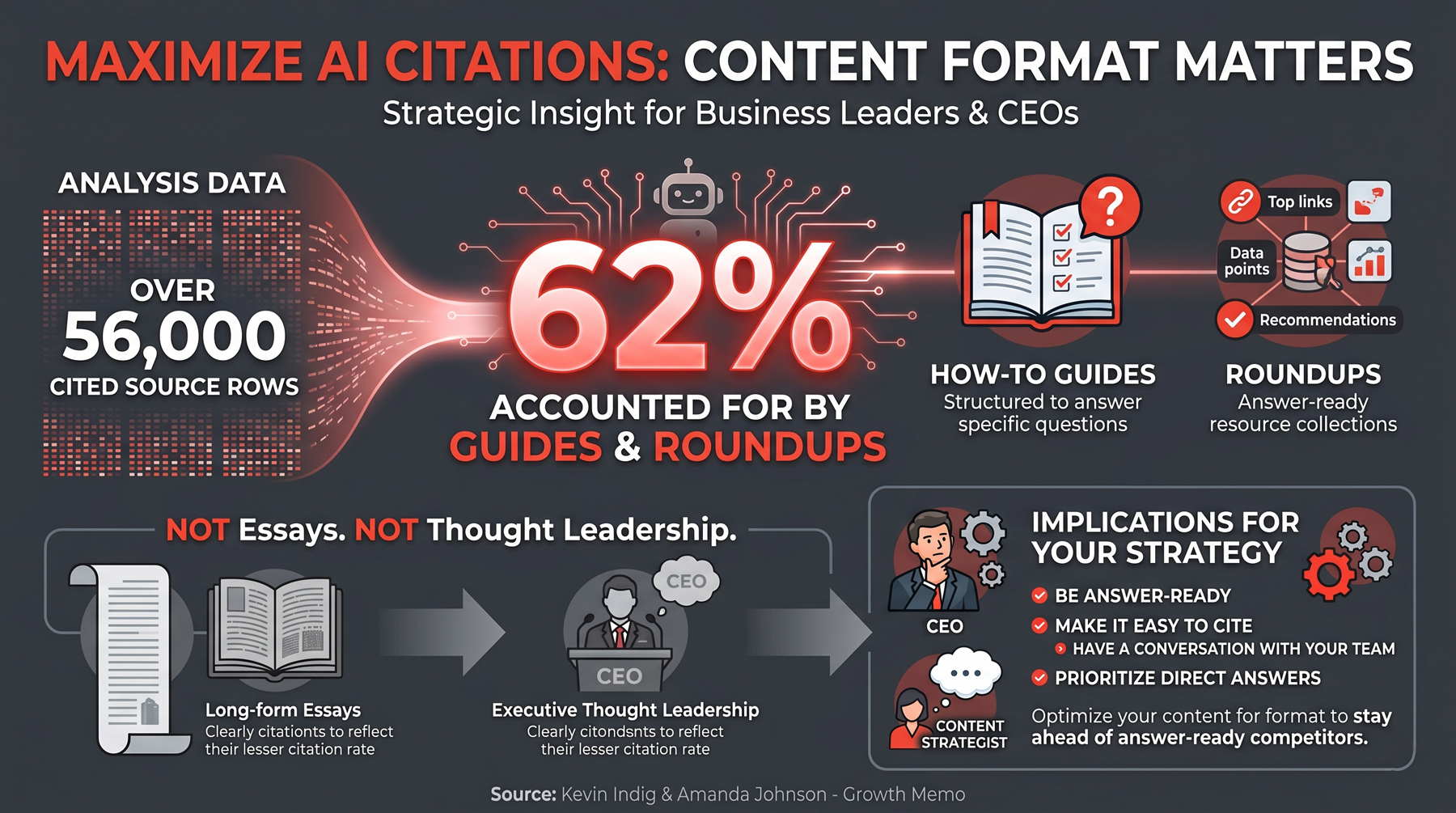
AI is looking for content it can actually use to respond to what’s being asked. If your content doesn’t answer a question cleanly and directly, you’re making yourself harder to cite — regardless of how authoritative your brand is in other respects.
This is worth a conversation with whoever manages your content strategy. Not because format is everything, but because you can be doing everything else right and still lose ground to a competitor whose content is simply more answer-ready.
You can be doing everything right and still lose — if your content isn’t structured to answer the question being asked.
Three questions worth asking
I’m not going to give you a six-step tactical plan here. That’s not what this is for. But I do want to leave you with three questions that are worth putting in front of your leadership team:
Do you know which specific topic set AI currently associates your brand with? Not the topics you want to own. The ones AI already connects to your category. Your visibility strategy needs to start from there.
Are you building authority in the sources that AI actually trusts for that topic? Not the biggest names in media in general — the specific publications, analysts, and experts that AI is pulling from when someone asks about your domain. Those are often different lists.
Is there a named person in your organization publishing under their own name on this topic? Indig and Johnson note something that their testing is starting to confirm: a named author with a real track record — someone who’s written across multiple sites, holds relevant credentials, and has an active professional presence — gives AI something to anchor authority to. A faceless brand post doesn’t. That’s an architectural shift worth thinking about, not just a content decision.
Aim Better
The businesses that figure this out first aren’t going to win because they outspent their competitors. They’re going to win because they aimed better.
Authority that’s topic-specific, built in the right sources, attached to real human experts — that’s what earns you a seat in the conversation AI is having with your future customers.
Everything else is just noise that the model ignores.
COMPLETE THE FORM TO
BOOK A STRATEGY CALL
"*" indicates required fields
CHAPTERS:

COMPLETE THE FORM TO
BOOK A STRATEGY CALL
"*" indicates required fields
Subscribe and Share – WE APPRECIATE YOUR SUPPORT