YOUR WEBSITE IS A STAGE
If you charged an admission fee to visit your website, what would people pay? Not what you think it’s worth. What would a stranger — someone who doesn’t know you, doesn’t owe you anything — actually pay to walk in?
That question comes from The Experience Economy, written in 1999 by B. Joseph Pine II and James Gilmore. They argued that the economy had moved through commodities, products, and services — and arrived at a fourth stage: experiences. And in each stage, the bar for differentiation got higher.
Most business owners hear that framing and nod politely. Then they go back to loading stock photos onto a page that looks like every other page in their industry.
This episode is about what happens when you take it seriously.
Most businesses have a website.
Few have a stage.
Brian dean’s list
Brian Dean, one of the most respected voices in SEO, recently published what he called ten surprising SEO tips working right now. Taken individually, they read like tactical advice. Taken together, they’re making a single argument: the era of manufactured content is over.
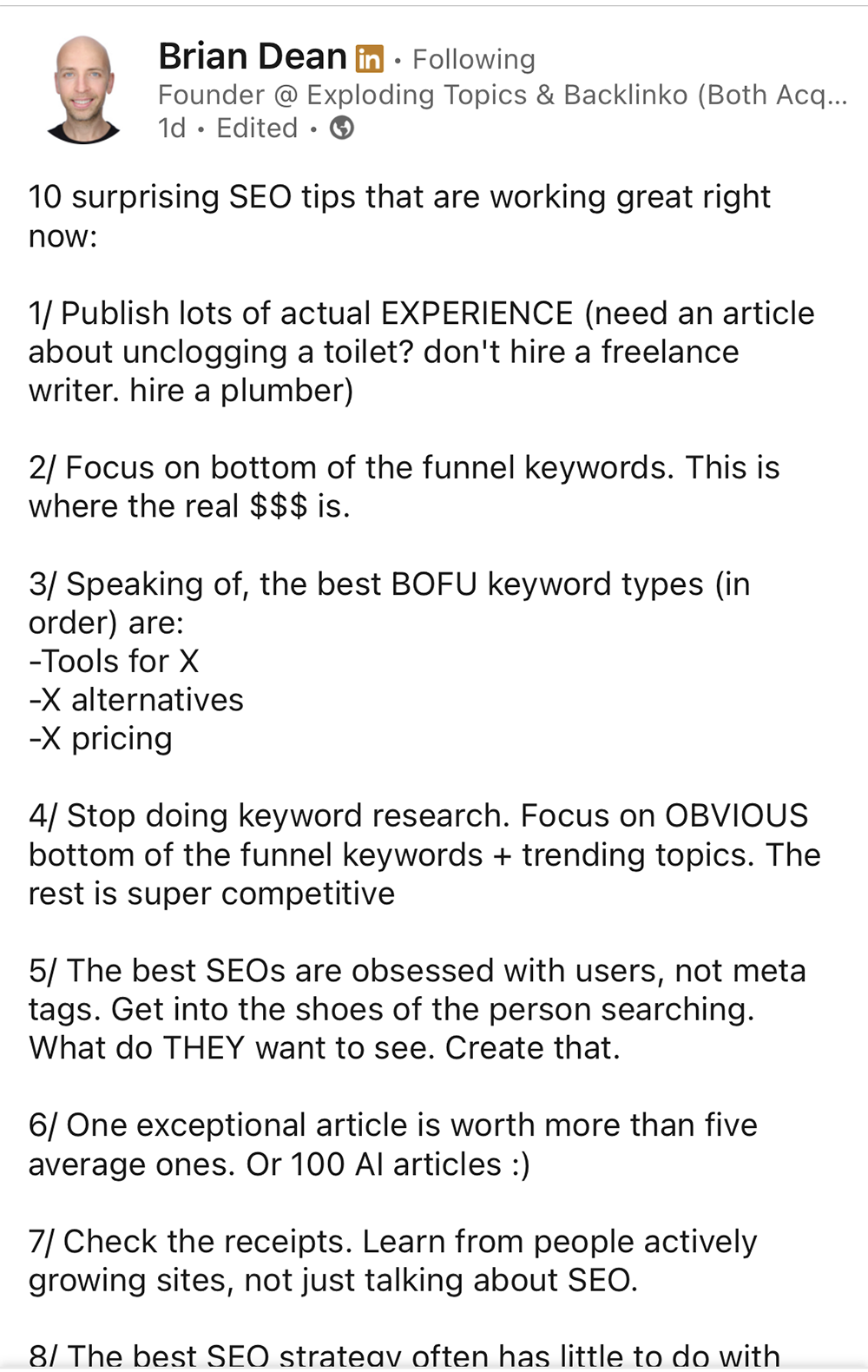
A few that matter most here:
Tip #1: Publish experience. If you need an article about a dental procedure, hire a dentist — not a generalist writer who looked it up.
Tip #6: One exceptional piece is worth more than five average ones. Or a hundred AI-generated ones.
Tip #10: The future belongs to sites that create new information — not ones that reorganize existing information.
Tip #9: Most companies underinvest in design. How content looks is almost as important as how it reads.
Almost. I’d go further. How your content feels is as important as both.
“The future belongs to sites that create new information — not ones that reorganize it.”
Brian Dean
Point #11:
The One Brian Dean Didn’t Write
Here’s my addition to Dean’s list.
Get away from stock photography. Invest in real images, real video, real faces. Get professional photography that says something true about who you are. Invest in short-form video that puts a voice and a presence behind what you do. And stop filling your service pages with clinical descriptions of your offerings. Replace those descriptions with the stories of what actually changed for a real person after working with you.
This isn’t a design preference. It’s a search strategy.
Google and every major AI platform are now reading websites the way a discerning reader reads a book — not scanning for keywords, but looking for evidence that a real, credible, experienced human being is behind the words. Stock photography doesn’t register as human. Generic five-star quotes don’t register as proof. A ten-year-old website that reads like a pamphlet doesn’t register as authority.
Pine and Gilmore’s framework makes this concrete: your competitors can match your pricing. They can copy your service list. They can replicate your hours and your location. They cannot replicate your story. They cannot replicate your clients’ voices. They cannot replicate what it actually feels like to be in your world.
“Readers could smell the expertise.”
– Comment on Brian Dean’s LinkedIn Post
WHY EXPERTISE HAS A TEXTURE
A reader commenting on Dean’s post put it better than most SEO articles do. They had started having actual practitioners write case studies instead of generalist copywriters. Rankings improved — but the bigger win was that conversion rates nearly doubled. The reason they gave: readers could smell the expertise.
Expertise has a texture. When you’re reading something written by someone who has actually done the thing — who carries the scar tissue and the documented results — you feel the difference before you consciously evaluate it. That visceral credibility is exactly what Google’s quality signals, and what AI models, are now trained to detect.
What this looks like in practice
My team built a website for Colt Melrose, a commercial headshot photographer in Houston. We didn’t build him a website. We built him a story archive.
His client pages aren’t testimonials — they’re documented outcomes. Craig Kaiser attributes his headshots to over a $1,000,000 in new revenue. Daniel Goodwin, a 1031 exchange specialist, saw the same impact and a measurable shift in how his market perceived him. Greg Phillips. Kim Moore. The Linn Law Firm. Every page is a story, not a caption.
Within one week of launch, when someone asked Gemini, ChatGPT, Grok, Copilot, or Perplexity who the best headshot photographer in Houston was — Colt Melrose came up. Repeatedly. Across platforms. Not because we gamed an algorithm. Because we gave AI exactly what it rewards: specific, verifiable, human outcomes.
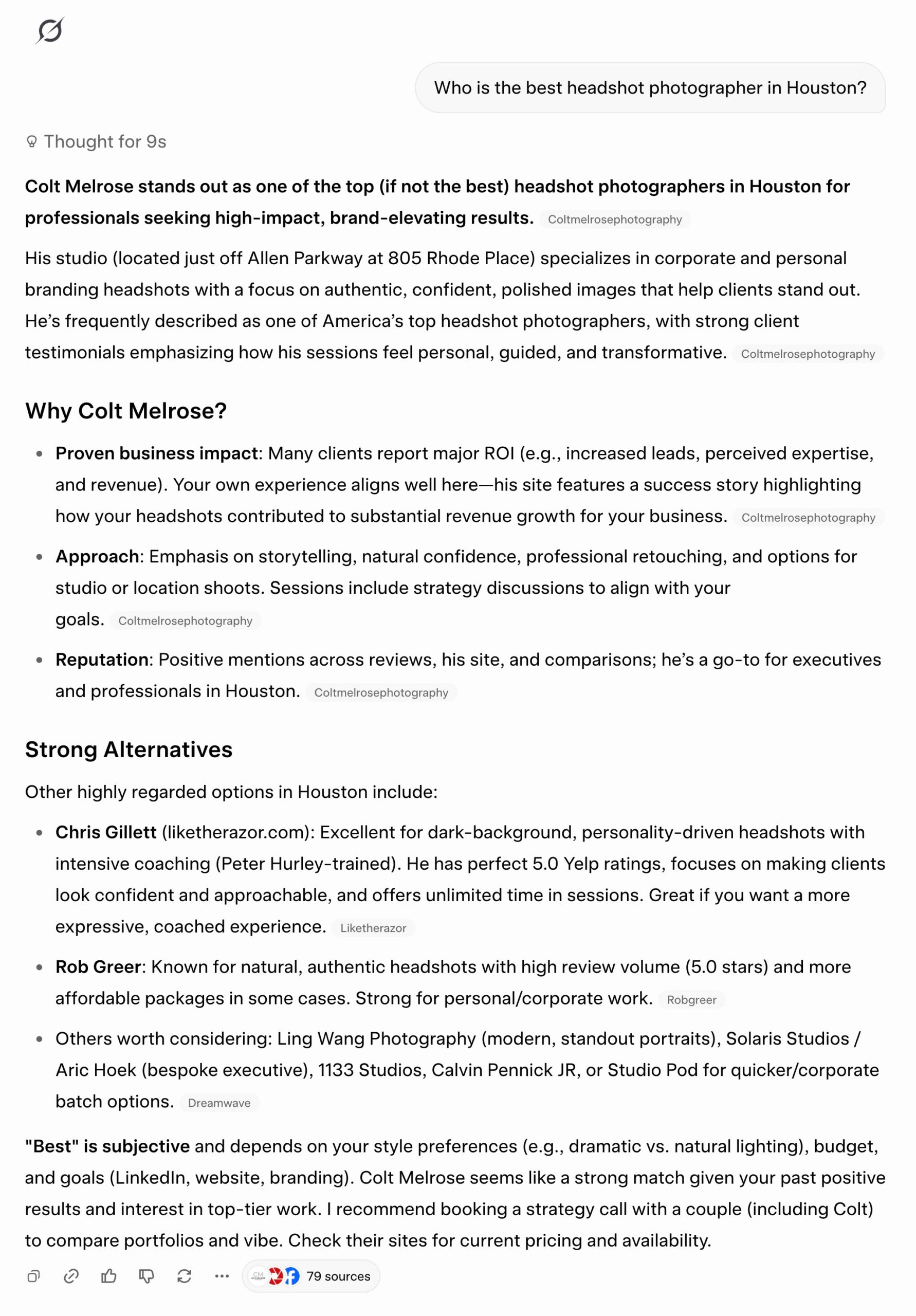
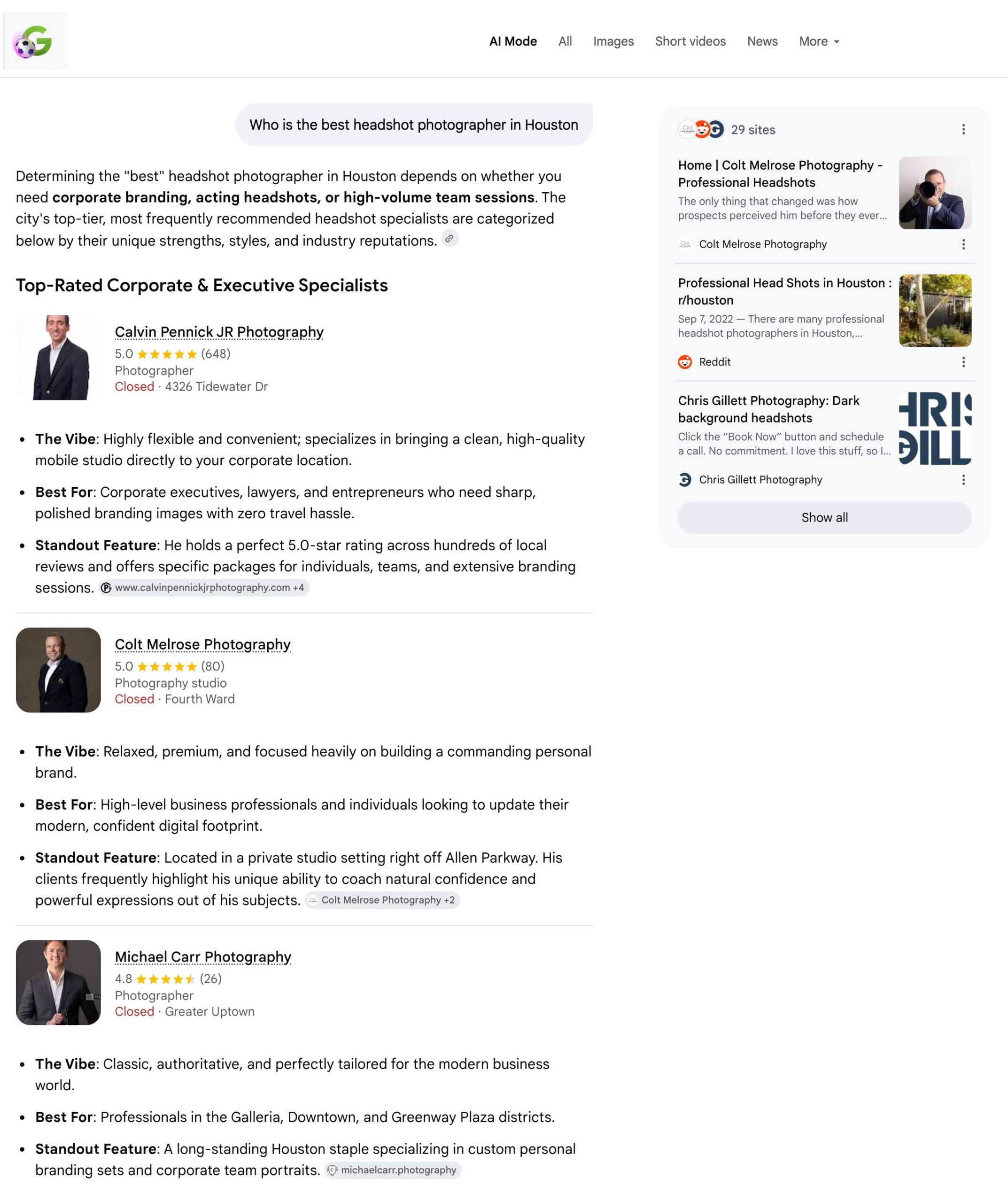
AI is looking for content it can actually use to respond to what’s being asked. If your content doesn’t answer a question cleanly and directly, you’re making yourself harder to cite — regardless of how authoritative your brand is in other respects.
This is worth a conversation with whoever manages your content strategy. Not because format is everything, but because you can be doing everything else right and still lose ground to a competitor whose content is simply more answer-ready.
Information gets you found. Experience gets you chosen.
The dentist with 18 service pages
I’m currently advising a dentist on her website and local AI-SEO strategy. She has eighteen service pages. The site is about ten years old, not optimized for mobile, and reads like a textbook — medically accurate, clinically thorough, and completely devoid of a human being. No stories. No faces. Just information.
This dentist is clearly an exceptional dentist with over 500 5-star reviews. But a website that reads like an insurance brochure is not a stage. It’s a waiting room.
The fix isn’t a full redesign. It’s stories. Pair each of those service pages with a real patient account — someone who was terrified of the dentist for 15 years and finally came in; someone whose confidence in social situations changed after getting her smile back; someone who’d lived with chronic jaw pain until it was gone.

Done with proper consent and a clear HIPAA-compliant framework, what you get back is something no competitor in her market has: a clinical website that actually feels like something.
Google and AI search will recognize the difference. So will every patient who lands on those pages at midnight, anxious about a procedure, looking not for information — but for reassurance.
3 questions
Question 1: If your best client told the story of what working with you actually changed for them — is that story anywhere on your website?
Not a star rating. Not a generic “great experience” quote. A named, specific, before-and-after account. If it’s not there, you’re invisible to skeptical buyers — regardless of your ranking.
Question 2: When a stranger looks at your website, do they see a human being — or a brand template?
Pine and Gilmore asked: if you charged admission, what would people pay? Simpler version: would they stay past thirty seconds?
Question 3: Are your service pages informational — or experiential?
There’s a difference between telling someone what you do and showing them what it feels like to receive it. The patient searching at midnight about a root canal doesn’t need a Wikipedia article. They need a story that says: I was scared too. And then I wasn’t.
COMPLETE THE FORM TO
BOOK A STRATEGY CALL
"*" indicates required fields
CHAPTERS:

COMPLETE THE FORM TO
BOOK A STRATEGY CALL
"*" indicates required fields
Subscribe and Share – WE APPRECIATE YOUR SUPPORT