YouR CRM
IS NOT A STRATEGY.
IT’S A DASHBOARD.
This Article Is Human Authored
By Jeff Payne
Get an AI Summary of this post on:


I bought a book on a Friday night. An advanced HubSpot strategy book. Amazon delivered it the next morning, and I tore into it the way I used to tear into new marketing playbooks when I was coming up — expecting the thing to knock my socks off.
I’m not through with it yet, but my socks are still firmly on my feet.
Don’t misunderstand me. HubSpot is excellent. I’d put it alongside Salesforce as one of the two finest CRMs in the world. But the book promised advanced strategy, and what I found was the same architecture every CRM has been selling for a decade: email sequencing, landing pages, lead scoring, list segmentation, behavioral triggers, automated workflows, and dynamic content tied to the customer journey.
All good. All necessary. None of it revolutionary.
And that’s the point. Because somewhere along the way, we started confusing the tool for the strategy. We started believing that if we just configured the dashboard correctly — if we just got the workflows right and the lead scoring dialed in — we’d crack the code on growth.
We won’t. And here’s why.

COMPLETE THE FORM TO
BOOK A STRATEGY CALL
"*" indicates required fields
The Tool Is Never The Strategy
CRMs are engines. They do exactly what engines do: they create efficiency, predictability, and visibility. A great CRM gives your CEO a real-time dashboard of what’s working and where it’s broken. It brings marketing and sales under one roof. It lets you track a lead from first touch to closed deal.
That’s enormously valuable. I’m not dismissing it.

But an engine without a destination is just burning fuel. And most companies I encounter have beautifully configured engines that aren’t going anywhere interesting. They’ve got the HubSpot portal humming, the Salesforce instance customized, the workflows automated — and they’re still struggling to differentiate themselves from every competitor who has the exact same setup.
The pace of change makes this worse, not better. Tools like Nexus, Black Forest Labs, and Contextual AI are being deployed in real time — faster than any team can evaluate them. The marketplace is accelerating. But tools are transient. Only strategy survives the acceleration.


This is one of the best written, most informative email newsletters I’ve ever read!
Thank you for sharing your expertise, and hope you’re doing well.
Beth Zimmerman
Founder, Executive Director

The New Imperative:
CreatE art
What replaced the information advantage? Experience.
Not “customer experience” in the sanitized, corporate-deck sense. I mean the visceral, emotional, memorable encounter a person has when they engage with your brand across every platform. I mean making someone feel something. I mean art.

In a B2B context, art doesn’t look like a PDF. It looks like something people would pay for — even when you don’t charge.
Let me show you what I mean.
Case Study 1: How A Masterclass Made the Competition irrelevant
Three years ago, Daniel Goodwin of Provident 1031 had the same problem every investment company has: he looked like every other investment company. Professional website. Competent content. Thoroughly forgettable.
We decided to steal an idea from MasterClass.com.
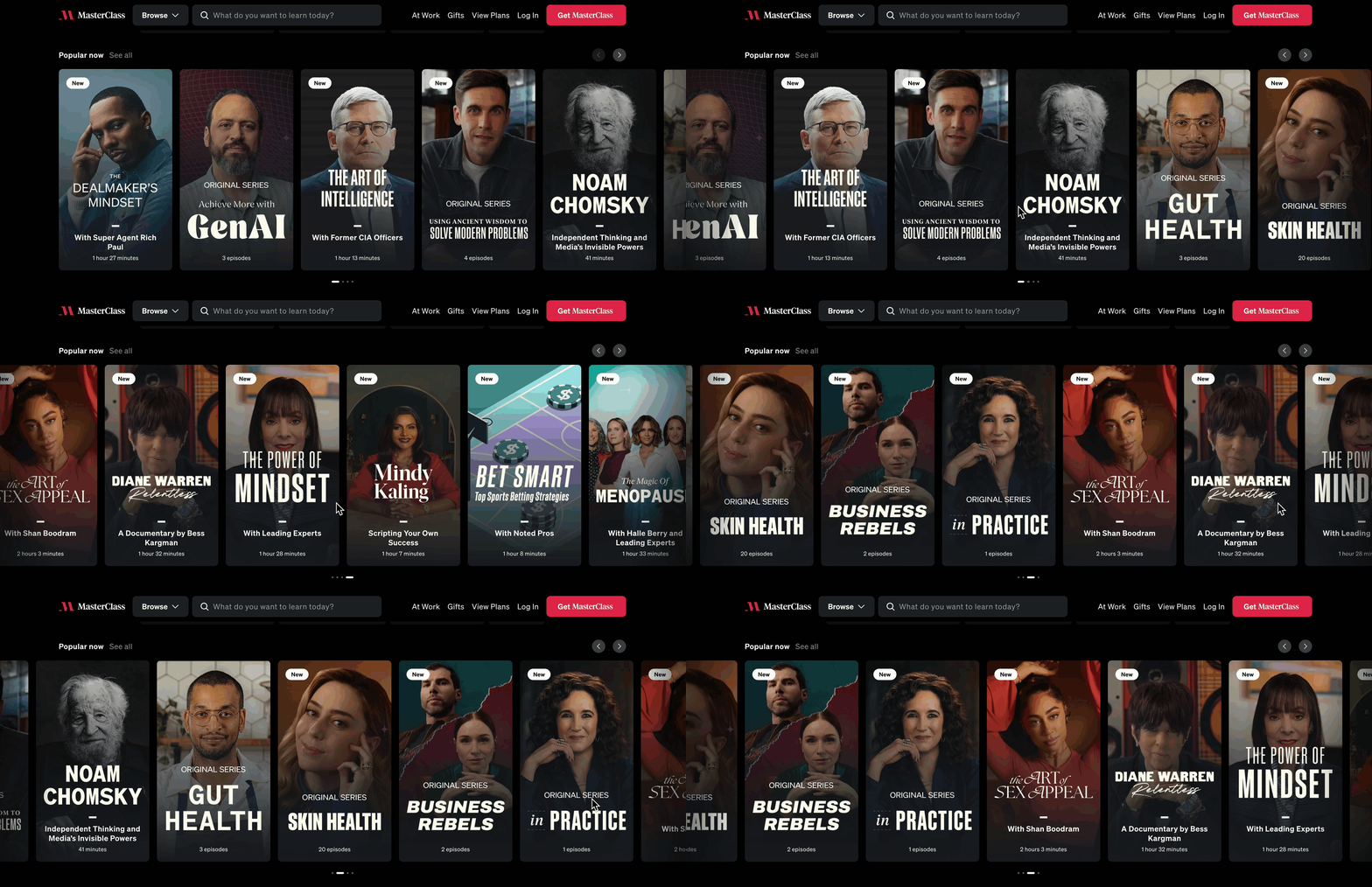
We built a professional Masterclass series around the 1031 Exchange — Daniel’s core expertise. But we didn’t build a webinar. We didn’t build a “video resource.” We built something with the production quality, pacing, and authority of a MasterClass.com course. Professionally written. Cinematic. Daniel positioned as the consummate expert in his field. Educational, yes — but also entertaining, thought-provoking, fast-paced, and engaging.
Something people would pay for. Even though we don’t charge to view.

That single Masterclass has generated more high-net-worth leads and sales for Daniel’s business than any other marketing strategy he has ever deployed. His words, not mine: “For every dollar we spend with you we are putting at least 5 back into our pocket AFTER we subtract what we spent. That’s an amazing cost/benefit that I have never received before in any of our previous marketing endeavors.”
That success spurred more Masterclasses. We added a Qualified Opportunity Zones Masterclass. Then four Oil & Gas Tax-Smart Strategy Masterclasses. This month, we’re launching a redesigned website and just published a new book on Amazon — How To Build Tax-Free Wealth Using A Delaware Statutory Trust — to deepen Daniel’s authority and separate him from virtually every competitor in the space.


Daniel didn’t out-spend his competition. He out-experienced them. The Masterclass didn’t just generate leads — it pre-qualified them. By the time a prospect finished watching, they weren’t evaluating Daniel against three other advisors. They were ready to call him.
Daniel didn’t outspend his competition. He out-experienced them. The Masterclass didn’t just generate leads — it pre-qualified them.


For every dollar we spend with you we are putting at least 5 back into our pocket AFTER we subtract what we spent.
That’s an amazing cost/benefit that I have never received before in any of our previous marketing endeavors.
Daniel C Goodwin
Provident 1031
Chief Investment Strategist
July 4, 2025
Case Study 2: The $1,000,000 Headshot
We’re doing the same thing right now with Colt Melrose, one of America’s most sought-after headshot photographers, based in Houston.Colt’s new website — launching later this month — isn’t a photography portfolio. It’s a narrative platform. It features “$1,000,000 Stories”: real clients who attribute at least one million dollars in additional revenue directly to the professional headshots and brand coaching Colt provided. Not testimonials buried at the bottom of a page. Full-length, cinematic, story-driven case studies that make the business case for professional photography undeniable.


We’re developing The $1,000,000 Headshot Masterclass — a nine-episode video series at coltmelrosephotography.com with production quality video and storyboard. And we’re writing and publishing Colt’s book, The Million Dollar Headshot, targeted for release by early 2027.
The new Colt Melrose Photography website, the Masterclass, and the book aren’t three separate marketing tactics. They’re a unified experience platform. Each drives the other. Each deepens Colt’s authority. And each makes comparing Colt to another photographer feel absurd — because you’re no longer comparing photographers. You’re comparing categories.
We wanted a website that stood above every other professional headshot photography site in the country. Maybe the world. We think we achieved it.
This is the difference between marketing and art.
Marketing informs.
Art transforms.
What these examples
Have in common
Daniel Goodwin and Colt Melrose operate in completely different industries. But the strategy is identical:
They stopped competing on information and started by transforming the customer experience. The Masterclass format, the cinematic storytelling, the book ecosystem, the brand-level website design — was about delivering information in a way that a prospective customer couldn’t find elsewhere. It’s is about delivering information in a way that creates an emotional response, builds trust, and makes the competition irrelevant.
This is the difference between marketing and art. Marketing informs. Art transforms. And in a world where AI can inform anyone about anything in seconds, transformation is the only advantage left.
They stopped competing on information and started by transforming the customer experience.
THE FUNNEL IS DEAD.
PRESENCE IS EVERYTHING.
Here’s the other thing nobody wants to say out loud: there is no funnel.
The traditional marketing funnel assumed a linear journey — awareness, consideration, decision — with your company guiding the prospect at each stage. That model depended on the prospect needing you for information at every step.
AI obliterated that dependency. Today, a prospect can move from problem-aware to solution-educated without ever interacting with a single salesperson. AI is their advisor now — available at any hour, with no agenda, answering every question they have. The funnel didn’t just change shape. It evaporated.

What replaced it? Presence.
Great marketers don’t guide prospects through a funnel anymore. They create such memorable, distinctive experiences that when a prospect is ready to buy — on their timeline, not yours — you’re the name they remember. Not because you nurtured them through a seven-step email sequence — but because you were unforgettable.
That means your CRM still matters — it captures the signals, tracks the digital body language, processes the data. You still deliver an email sequence, but it’s an experience and not a boring email. The CRM is the dashboard, not the driver. The driver is the experience you create.
The ONE QUESTION EVERY BUSINESS
NEEDS TO ANSWER
If ChatGPT can explain what you do in 15 seconds for free, what are you actually selling?
Not what are you offering. Not what are your services. What transformation do your customers experience that they cannot replicate with a free AI tool, cannot get from a competitor, and cannot find anywhere else?
If you can answer that clearly, you have a business model built for this era.
If your answer still lives in a PDF — in a guide, a white paper, a blog post that explains what you know — you’re selling something that’s already been disrupted. You just haven’t seen the 76% drop yet.
The attention economy is closing. The intimacy economy is opening. And the price of admission is art.
Not competence. Not information. Not content volume.
Art. Courage. The willingness to build something nobody in your industry has built before.
The businesses that make that investment now will own the next decade. The ones that don’t will keep producing content and wondering where the audience went.
COMPLETE THE FORM TO
BOOK A STRATEGY CALL
"*" indicates required fields
The ONE QUESTION EVERY BUSINESS
NEEDS TO ANSWER
None of this matters if you can’t be found. And being findable in 2026 means something fundamentally different than it did even two years ago.
It means being the answer AI gives when someone asks a question in your domain. Not one of the answers. The answer.
Position 1 in AI search generates roughly three times the revenue of Position 2. It generates approximately 12.5 times the revenue of Position 3. By Position 4, the revenue impact is a rounding error.

This is a citation game now, not a click game. The strategic shift isn’t “get the click” — it’s “get the citation.” And the brands earning citations are the ones creating the kind of authoritative, experience-driven content I’ve been describing. The ones producing art.
I wrote about this in depth here: Why Position #1 in AI Search Is the Only Position That Matters.
The truth
Here’s what I know after decades in this business: the companies that thrive in the next five years won’t be the ones with the best CRM configuration. They’ll be the ones that figured out how to create experiences so compelling that prospects choose them before the sales conversation ever starts.
Your HubSpot is great. Your Salesforce is great. I love tools. I’m a tools person.
But tools will always change. Strategy endures. And the strategy that endures right now is this: stop giving people information. Start giving them something they’ll never forget.
That’s art. And it’s the hardest work you’ll ever do.
COMPLETE THE FORM TO
BOOK A STRATEGY CALL
"*" indicates required fields