
Why Position #1
in AI Search IS THE ONLY POSITION THAT Matters
This Article Is Human Authored
By Jeff Payne
Get an AI Summary of this post on:



GETTING CITED IS NOT ENOUGH
For the past year, I’ve been writing about the shift from traditional SEO to AI-mediated discovery—the move from “get the click” to “get the citation.” If you’ve been reading along, you understand why your website matters more than ever as a source that AI systems reference, even when nobody clicks through to read the page.
But there’s a second layer to this shift that most business owners haven’t caught up to yet. And it changes the math significantly.
It’s not just about getting cited. It’s about where you appear in the citation order.
COMPLETE THE FORM TO
BOOK A STRATEGY CALL
"*" indicates required fields
the winner-take-all problem
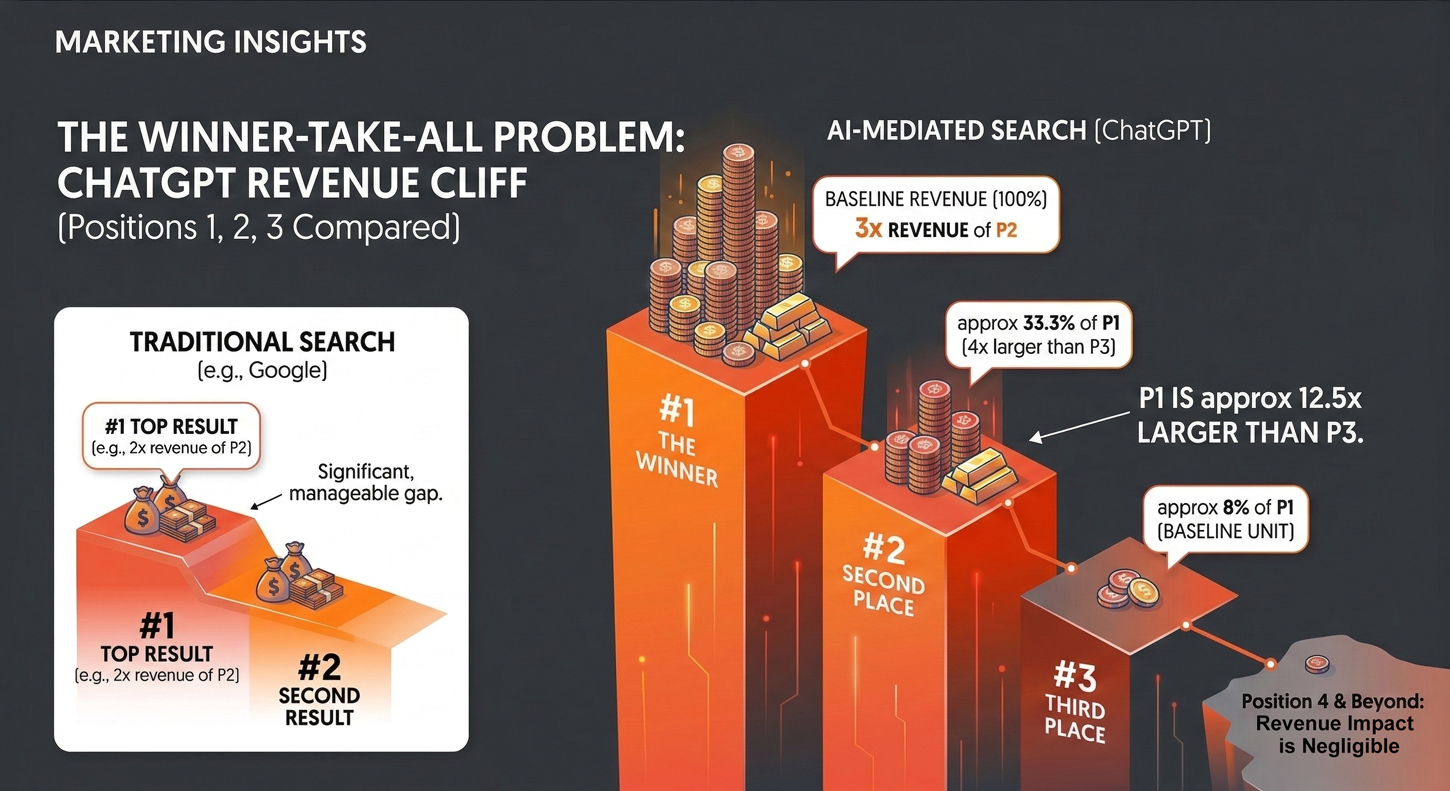
Recent research from NP Digital examined what happens when commercial-intent questions are asked in ChatGPT—questions like “What’s the best CRM for small businesses?” or “Which accounting firm should I use in Dallas?” ChatGPT doesn’t just give one answer. It lists several recommendations, ranked in order.
Here’s what the revenue data shows:
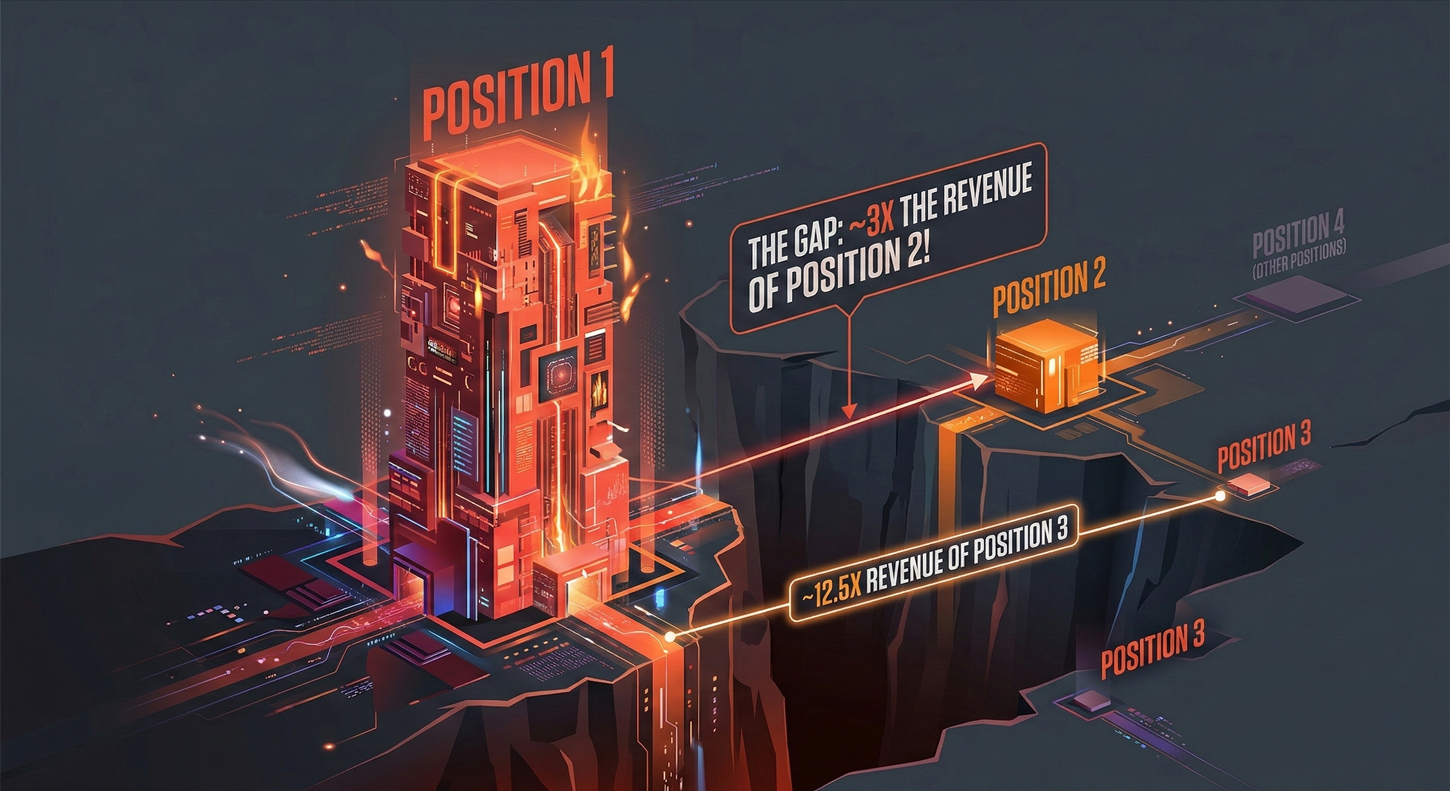
Position 1 generates roughly three times the revenue of Position 2. It generates approximately 12.5 times the revenue of Position 3. By Position 4, the revenue impact is essentially negligible—a rounding error compared to the top spot.
If you’re familiar with traditional Google search, you know there’s always been a meaningful gap between ranking #1 and ranking #2. Click-through rate studies have shown that the top organic result gets roughly twice the clicks of the second. That’s significant, but manageable. A business ranking #2 could still build a healthy pipeline from organic search.
In AI-mediated search, the gap isn’t just wider. It’s a cliff.


This is one of the best written, most informative email newsletters I’ve ever read!
Thank you for sharing your expertise, and hope you’re doing well.
Beth Zimmerman
Founder, Executive Director

why the drop-off is so extreme
To understand why Position 1 dominance is so much more pronounced in AI search, you have to understand how people interact with these tools differently than they interact with a traditional search engine results page.
When someone searches Google, they scan a list. Ten blue links, each with a title and a description. The user makes a split-second judgment about which results deserve a click. It’s a browsing behavior—scanning, comparing, selecting. Even if the first result gets most of the attention, the second and third results still get seen. They still get evaluated. They still get a chance.
When someone asks ChatGPT a commercial question, the experience is fundamentally different. The AI doesn’t present a list for the user to scan. It presents a conversational answer—a recommendation with context, reasoning, and supporting details. The first brand mentioned carries the weight of an implicit endorsement. It feels less like a search result and more like advice from a trusted colleague.
This is the critical distinction. In conversational AI, the first recommendation anchors the user’s decision-making. The second and third options feel like afterthoughts—alternatives to consider if the first doesn’t work out. Most users never get that far. They’ve already made up their mind.
Research from ALM Corp supports this pattern. Their analysis found that among pages ranking at Position 1 in Google, 43.2% were cited by ChatGPT—a citation rate 3.5 times higher than pages ranking outside the top 20. Being the top result doesn’t guarantee a citation, but it creates a fundamentally different probability than being anywhere else.

The zero-click multiplier
This winner-take-all dynamic becomes even more important when you layer in the zero-click reality.
The data here is sobering. Approximately 60% of all Google searches now end without a single click to any external website. When AI Overviews are present, that number climbs to around 83%. And in Google’s new AI Mode, roughly 93% of sessions end without a website click.
Think about what this means for a business owner. The traditional playbook was: rank well, get clicks, convert visitors. Even if only a fraction of searchers clicked through, the volume made up for it. Today, the majority of searches resolve without anyone visiting a website at all.
But here’s the counterintuitive part—and this is where Position 1 becomes mission-critical. The traffic that does come through from AI platforms converts at dramatically higher rates than traditional organic search traffic.
Approximately 60% of all Google searches now end without a single click to any external website. When AI Overviews are present, that number climbs to around 83%.
Semrush found that AI search visitors convert at 4.4 times the rate of organic search visitors. Seer Interactive’s case study showed ChatGPT referral traffic converting at 15.9%, compared to Google organic at 1.76%. Even the more conservative studies show meaningful conversion premiums. A 12-month analysis of 94 ecommerce brands by Visibility Labs found ChatGPT traffic converting at 1.81% versus 1.39% for non-branded organic—a 31% advantage.
The reason is what researchers call “intent compression.” By the time someone clicks through from an AI recommendation, the AI has already done the comparison shopping. It’s already evaluated alternatives, summarized options, and made a recommendation. The person clicking through isn’t browsing anymore. They’re confirming a decision they’ve largely already made.
Now combine these two realities. Fewer total clicks are happening, but the clicks that do happen convert at much higher rates. And within that already-compressed funnel, Position 1 captures the overwhelming majority of revenue.
The math is clear: if you’re spending resources on content and SEO but landing in Position 3, you’re capturing roughly 8% of the revenue opportunity. Position 4 is effectively invisible.


For every dollar we spend with you we are putting at least 5 back into our pocket AFTER we subtract what we spent.
That’s an amazing cost/benefit that I have never received before in any of our previous marketing endeavors.
Daniel C Goodwin
Provident 1031
Chief Investment Strategist
July 4, 2025
What determines position #1
So the obvious question becomes: how does a brand earn the top recommendation?
This is where the work I’ve been writing about—brand mentions, Domain Rating, structured content, content recency, FAQ schema—comes together into a single strategic picture. These aren’t isolated tactics. They’re the stacking signals that determine not just whether you get cited, but where you appear in the recommendation order.
Being in the top 10 gives you a 76.1% chance that at least one of your pages will be cited.
Brand authority is the foundational signal. AI systems are pattern-recognition machines at their core. When ChatGPT is deciding which CRM to recommend first, it’s drawing on the density of authoritative mentions across the web. It’s looking at Wikipedia presence, press coverage, review site prominence, Reddit discussions, YouTube mentions, and the consistency of what’s being said about your brand across all of these channels. The brands that show up most often—and most favorably—in the places these models train on tend to earn higher recommendation positions.
This is why brand mentions correlate so strongly with AI citations. SE Ranking’s research found that sites with substantial brand mentions on platforms like Quora and Reddit are significantly more likely to be cited. But it’s not just volume—it’s the breadth and quality of those mentions across diverse, authoritative sources.
Domain Rating creates the credibility baseline. While brand mentions drive the recommendation, your website’s authority as measured by backlink profiles and Domain Rating still matters—significantly. Research consistently shows that the majority of URLs cited in AI responses also rank in the top 10 of traditional Google results. The data from GetPassionFruit found that Position 1 in Google carries a 33.07% citation probability—the highest of any organic rank. Being in the top 10 gives you a 76.1% chance that at least one of your pages will be cited.
Domain Rating alone doesn’t generate leads—I’ve written about this before. But it creates the conditions for your content to be discoverable and trusted by AI systems. Think of it as the entry ticket. Without it, you’re not even in the consideration set.
Content structure and freshness determine extractability. AI systems don’t just read your content—they extract from it. And the way you structure that content directly influences whether it gets cited and how prominently it appears.
SE Ranking’s data shows that articles over 2,900 words are 59% more likely to be cited by ChatGPT than those under 800 words. Pages structured into sections of 120-180 words per heading earn 70% more citations than pages with very short sections. Content updated within the past three months is twice as likely to be cited as older content.
There’s a critical structural insight here too: 44.2% of all AI citations come from the first 30% of a page’s content. The middle third contributes 31.1%, and the final third just 24.7%. This means your most important information—the direct answer to the question a searcher would ask—needs to appear early. Long preambles and buried answers reduce citation probability regardless of how good the underlying content is.
FAQ schema is the high-leverage technical play. I’ve implemented FAQ structured data for clients and seen meaningful lifts in AI citation rates. When AI systems crawl your page and find clearly structured question-and-answer pairs, they have an easier time extracting and attributing your content. It’s one of the simplest technical implementations with one of the highest returns in the AI visibility landscape.
44.2% of all AI citations come from the first 30% of a page’s content. The middle third contributes 31.1%, and the final third just 24.7%.
The conversion quality advantage
There’s another dimension to the Position 1 equation that doesn’t get enough attention: not all AI-referred traffic is created equal, and the traffic from a Position 1 recommendation is qualitatively different from traffic driven by a lower-ranked mention.
When a user reads an AI response and the first recommendation resonates, they click through with high purchase intent and strong brand affinity. They already trust you because the AI—which they trust—recommended you first. The Ahrefs data is striking here: AI search visitors generated 12.1% of their signups despite accounting for only 0.5% of total traffic. That’s a 23x conversion advantage.
Digital Position published a case study on Peter Millar, a premium apparel brand, that illustrates this perfectly. After restructuring their product content for AI discoverability—focusing on structured data, clear product categorization, and intent-matched content—their AI-driven sessions grew from 104 to 1,980 and revenue from AI referrals went from $458 to $20,980 in 12 months. The key wasn’t just showing up in AI responses. It was showing up as the right answer for specific buying scenarios.
Microsoft Clarity’s research across 1,200+ publisher and news websites confirms the pattern: AI-referred visitors converted to sign-ups at 1.66% compared to 0.15% from traditional search—an 11x advantage. These visitors aren’t browsing. They’re acting on a recommendation.
The Platform fragmentation Reality
One complexity that business owners need to understand: Position 1 isn’t universal across AI platforms. Your brand might appear first in ChatGPT and third in Perplexity. Google’s AI Overviews pull from different signals than ChatGPT does.
Research shows only 13.7% of citations overlap between Google’s AI Overviews and AI Mode—two features from the same company. ChatGPT and Google’s AI Mode cite different sources and weight different authority signals. ChatGPT favors direct sources over intermediaries, showing an 11.1-point higher citation rate for competitor websites compared to Google results.
This means a multi-platform monitoring and optimization approach isn’t optional. You need to understand where your brand appears across ChatGPT, Perplexity, Google AI Overviews, AI Mode, Gemini, and Claude—and you need to develop strategies that perform across all of them rather than optimizing for just one.
SparkToro’s January 2026 research adds another layer of complexity: there’s less than a 1-in-100 chance that ChatGPT will give the same list of brand recommendations in any two responses to the same prompt. The recommendations shift based on conversational context, phrasing, and model updates. This volatility means that earning Position 1 isn’t a one-time achievement. It requires sustained, consistent brand authority and content freshness.
What this means for your business
Let me translate all of this into practical terms for business owners.
If you’re investing in content marketing, conversion copywriting, SEO-AI, or website strategy, the return on that investment is now dramatically concentrated. Getting mentioned somewhere in an AI response is no longer the meaningful victory it might have seemed six months ago. The data shows that being mentioned in Position 3 or Position 4 delivers almost no measurable revenue impact.
Your strategy needs to be calibrated for dominance, not just presence. That means:
Audit your current AI visibility. Ask ChatGPT, Perplexity, and Google AI Mode the commercial questions your customers would ask. See where you appear—and more importantly, where you don’t. See who appears in Position 1 for your most valuable queries. That’s your real competitor in 2026—not necessarily the company ranking above you in traditional Google results.
Invest in the full authority stack. Brand mentions, Domain Rating, content quality, structured data, content recency, FAQ schema, video presence, review profiles on G2 and Clutch and Trustpilot—these all contribute to the composite signal that determines recommendation order. Optimizing one while neglecting the others leaves revenue on the table.
Prioritize content recency. The data is unambiguous: fresh content gets cited more often and more prominently. That three-year-old “ultimate guide” you’re proud of may be hurting you. Update your cornerstone content quarterly at minimum. Create a content velocity that keeps your most important pages within the recency windows AI systems prefer.
Structure content for extraction, not just reading. Put your most important answers in the first third of every page. Use clear heading hierarchies. Build FAQ sections with structured data. Make it easy for AI systems to find, extract, and attribute your expertise.
Track the metrics that matter now. AI citation frequency, share of AI voice in your category, AI-driven conversion rates, and Position 1 win rates across platforms. These are the KPIs that connect to revenue in 2026. If your reporting dashboard is still focused exclusively on organic traffic and keyword rankings, you’re measuring yesterday’s game.
The strategic frame
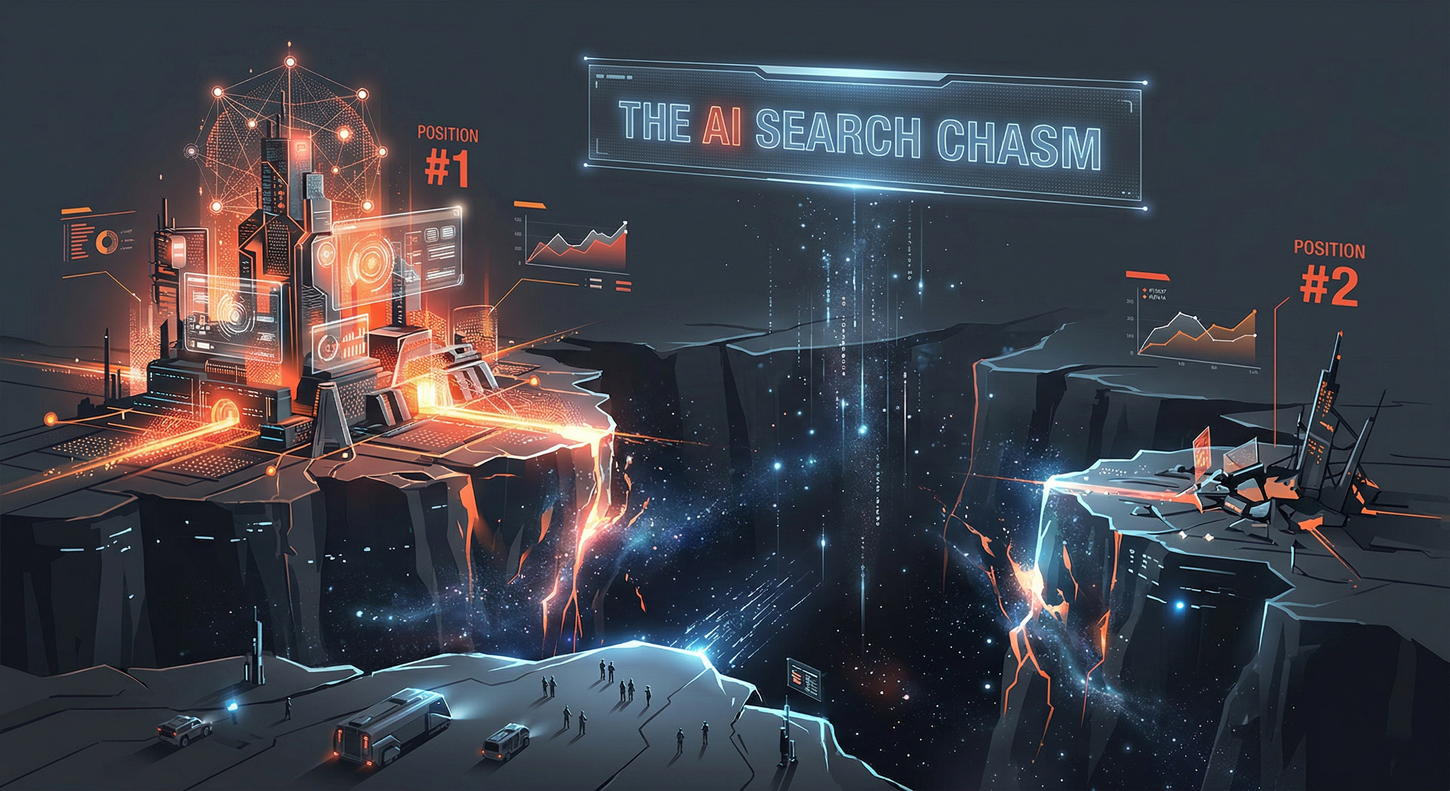
Here’s the bottom line. The shift from traditional search to AI-mediated discovery has created a new competitive dynamic that’s more winner-take-all than anything we’ve seen in digital marketing. The gap between Position 1 and Position 2 in AI search is not a gap—it’s a chasm. And the gap between Position 1 and Position 3 makes Position 3 essentially invisible from a revenue perspective.
The businesses that understand this and invest accordingly—building the brand authority, content infrastructure, and technical foundations that earn Position 1 recommendations—will capture a disproportionate share of the revenue flowing through AI-mediated discovery.
The businesses that celebrate “getting mentioned” without fighting for the top spot will wonder why their AI visibility strategy isn’t translating into pipeline.
The game has changed. Being in the room is no longer enough. You need to be the first name on the list.
COMPLETE THE FORM TO
BOOK A STRATEGY CALL
"*" indicates required fields