WHY BRAND MENTIONS
MATTER MORE THAN BACKLINKS
THE QUIET REVOLUTION
This Article Is Human Authored
By Jeff Payne
Get an AI Summary of this post on:



Your customers aren’t searching the way they used to.
Last week, I had two business owners reach out to me with variations of the same concern: “Our SEO is solid, we’re ranking well, but something feels different about how customers are finding us.” They’re right to be concerned. The game has fundamentally changed, and most businesses haven’t caught up yet.
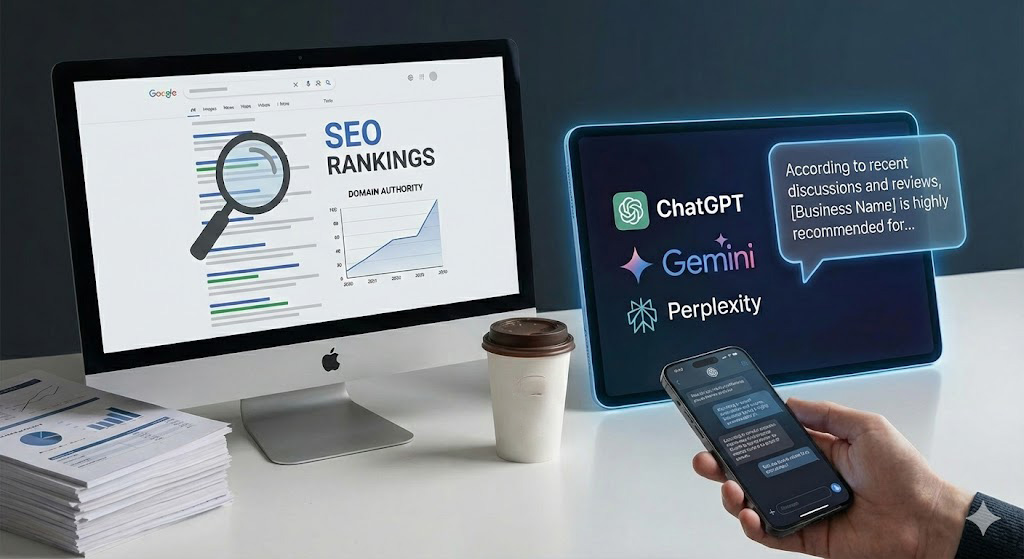
Here’s what’s happening: AI search tools like ChatGPT, Gemini, and Perplexity are rapidly becoming the default way people research products and services. And these AI assistants don’t care about your carefully optimized meta descriptions or your impressive domain authority. They care about something entirely different — who’s talking about you and what they’re saying.
the death of
“get the click”
For two decades, digital marketing has been obsessed with one metric above all others: clicks. We built entire strategies around getting people to click through to our websites. We optimized headlines, crafted meta descriptions, and played the backlink game to climb those search rankings.
But here’s the uncomfortable truth: AI doesn’t click.
When someone asks ChatGPT or Perplexity about the best solution for their business problem, these AI tools synthesize information from across the web and deliver a complete answer. No clicking required. No website visits tracked. Your Google Analytics dashboard stays silent while potential customers make purchasing decisions based on AI recommendations.
the data that should
keep you up at night
Ahrefs recently analyzed 75,000 brands to understand what makes companies appear in AI search results. The findings completely upend conventional SEO wisdom:
The strongest predictor of AI search visibility isn’t backlinks, domain authority, or even branded search volume. It’s brand mentions—conversations about your company happening across the web.
Look at these correlation numbers:
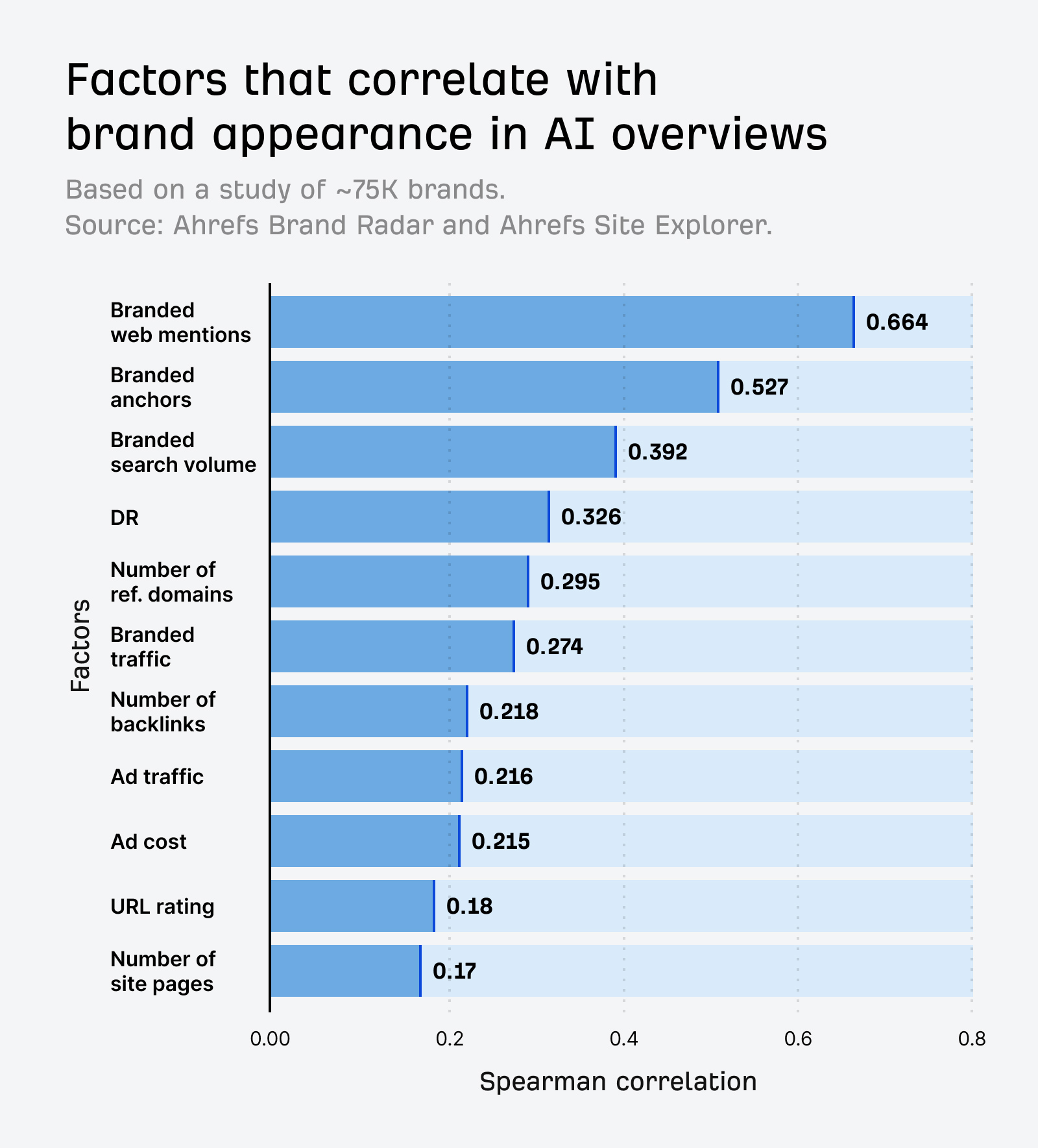
Brand mentions are three times more predictive of AI visibility than traditional backlinks. Let that sink in for a moment.
Even more striking: only 12% of the sources cited by ChatGPT, Gemini, and Copilot actually appear in Google’s top 10 results for the same search query. That means 88% of AI citations come from sources that traditional SEO would consider “unsuccessful.”
WHY AI PLAYS
By DIFFERENT RULES
Traditional search engines use links as votes of confidence. The more high-quality sites linking to you, the more authoritative you appear. It’s a system that worked well for twenty years.
But large language models (LLMs) don’t think in terms of links. They think in terms of context and credibility. When an AI evaluates information, it’s looking for:
A backlink without context is meaningless to an AI. But a detailed discussion of your product in a industry forum, a mention in a trade publication’s analysis, or a thoughtful review on a niche blog—these carry weight.
THE PUBLISHER
PARADOX
Here’s where it gets interesting for everyone in the ecosystem. Publishers are facing their own crisis. Without website traffic, they can’t monetize through display ads or affiliate links. The traditional value exchange is breaking down.
Smart publishers are already adapting. They’re shifting from chasing traffic to building authority as trusted sources that AI systems reference. And they’re looking for new monetization models—including direct relationships with brands who understand the value of contextual mentions alongside traditional links.
This creates a more complex opportunity for forward-thinking companies. You still need the SEO foundation—Domain Authority remains your table stakes for credibility. The Ahrefs data show on the earlier chart, you can see that Domain Rating maintains a meaningful 0.326 correlation with AI visibility. Without that baseline authority built through quality backlinks, AI systems won’t see you as a credible source worth citing, regardless of how many brand mentions you accumulate.


For every dollar we spend with you we are putting at least 5 back into our pocket AFTER we subtract what we spent.
That’s an amazing cost/benefit that I have never received before in any of our previous marketing endeavors.
Daniel C Goodwin
Provident 1031
Chief Investment Strategist
July 4, 2025
But here’s the shift: once you’ve established that credibility threshold through traditional SEO, brand mentions become your multiplier. They’re what push you from “credible source” to “cited recommendation.” Think of it as a two-layer strategy—backlinks get you into the room, brand mentions get you into the conversation.
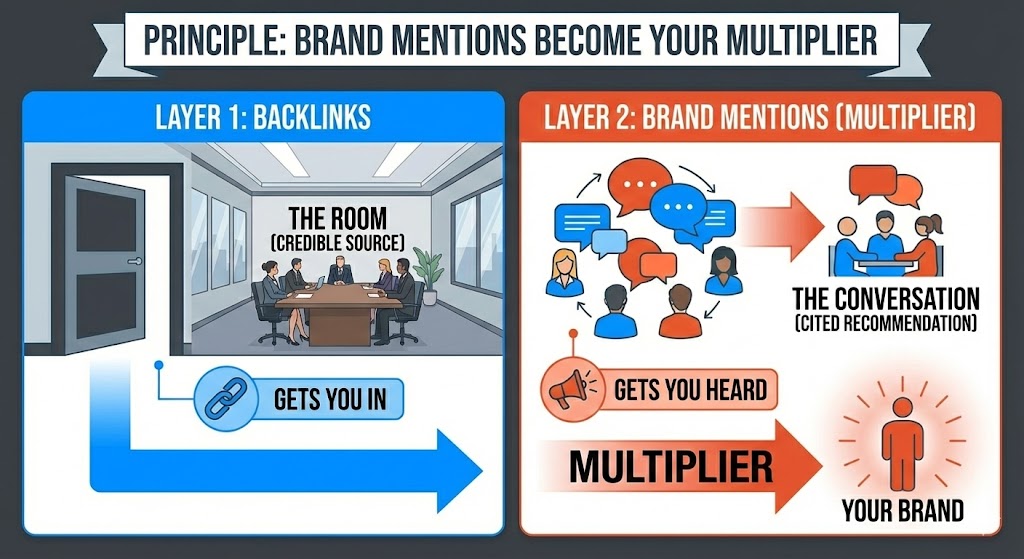
While your competitors are still putting 80% of their effort into link building alone, you can rebalance your portfolio. Build genuine relationships with publishers, industry analysts, and thought leaders who provide both—quality backlinks that maintain your domain authority AND contextual discussions that teach AI systems when and why to recommend you.
WHAT THIS MEANS
FOR YOUR BUSINESS
The shift from SEO to what some are calling GEO (Generative Engine Optimization) isn’t coming—it’s here. Every day your business isn’t adapting is a day you’re becoming less visible to AI-assisted buyers.
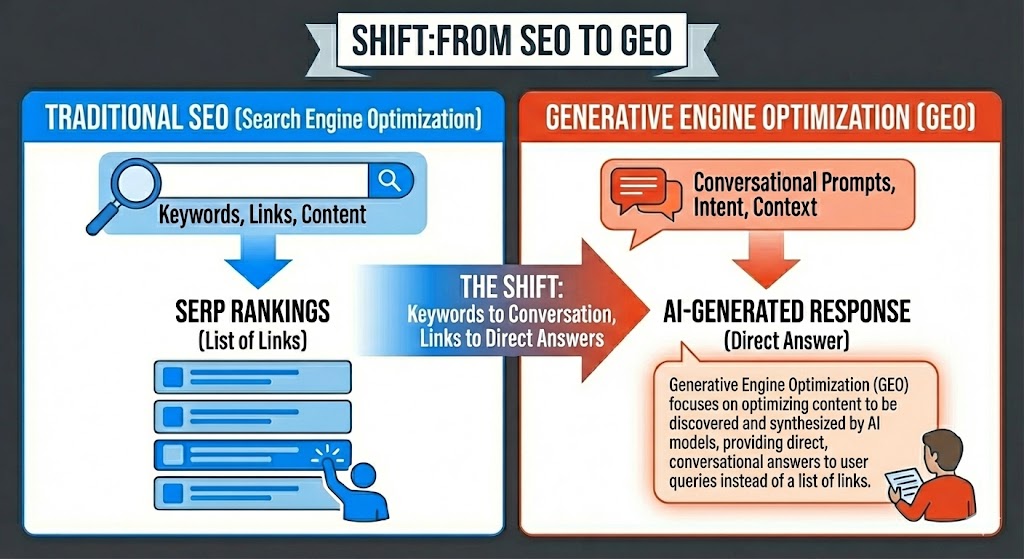
Consider this scenario: A potential customer asks Perplexity, “What’s the best solution for managing distributed teams?” or tells ChatGPT, “I need to modernize our supply chain management.”
Will your company appear in the AI’s response? Not because you rank #1 for those keywords, but because industry publications discuss you as an innovator? Because customers mention you in forums? Because thought leaders reference your approach in their analysis?
THE ACTION
PLAN
If you’re a CEO or business owner reading this, here’s what you need to do:
1. Audit your brand mentions
Start by understanding your current position. Where is your brand being discussed online? Not linked to—discussed. Industry forums, Reddit threads, trade publications, podcasts, YouTube videos. These conversations are your new SEO.
2. Shift from link-building to relationship building
Stop thinking about publishers as link sources. Start thinking about them as partners in building your narrative presence. A thoughtful case study in an industry publication is worth more than a hundred directory links.
3. Create mention-worthy moments
AI systems learn from human conversations. Give humans something worth talking about:
4. Expand your definition of “Publisher”
The sources AI systems reference are surprisingly diverse. Industry analysts, newsletter writers, podcast hosts, YouTube creators, even thoughtful LinkedIn commenters—they all contribute to the conversation AI learns from.
5. Measure what matters
Your SEO dashboard is lying to you about your future visibility. Start tracking:
The WINDOW
IS CLOSING
Here’s what most businesses don’t realize: we’re in a brief transition period where first movers have an enormous advantage. The companies that establish themselves as frequent subjects of credible discussions now will become the default recommendations as AI search adoption accelerates.
Your competitors are still obsessing over keyword rankings and backlink profiles exclusively. They’re optimizing for only half the game. Meanwhile, AI search platforms are rapidly growing their user base and reshaping how business decisions get made.
Perplexity alone now handles millions of queries daily. ChatGPT has over 200 million weekly active users. These aren’t early adopters anymore—they’re mainstream business users making purchasing decisions.
The CHOICE
IS YOURS
You can continue playing the traditional SEO game exclusively, watching your carefully optimized pages rank well while mysteriously failing to drive the business impact they once did.
Or you can recognize that search has fundamentally changed. That visibility now requires a dual strategy: maintaining your SEO foundation for credibility while building the brand conversations that drive AI citations. That your future customers are increasingly asking AI for recommendations, and those recommendations are based on both your domain authority AND who’s talking about you.
The companies that will thrive in this new landscape aren’t necessarily those with the biggest SEO budgets or the most backlinks. They’re the ones that understand this evolution: in an AI-driven world, backlinks establish your credibility, but brand mentions determine your visibility.
The question isn’t whether you need to adapt. It’s whether you’ll adapt before your competitors do.
COMPLETE THE FORM TO
BOOK A STRATEGY CALL
"*" indicates required fields