
DOES AI CITE
your business?
This Article Is Human Authored
By Jeff Payne
Get an AI Summary of this post on:



THE 5 FACTORS THAT DETERMINE WHETHER AI CITES YOUR BUSINESS
There’s a question I’ve been hearing more often from the business owners I work with, and it usually sounds something like this:
“We’re doing SEO. We’re creating content. But when I ask ChatGPT about our industry, we don’t show up. Our competitors do. What’s going on?”
It’s a fair question. And the answer is uncomfortable for a lot of companies that have spent years and real money building their online presence the traditional way.The rules changed. Not gradually — structurally.
Between 60 and 65 percent of all Google searches now end without a single click to any website. In Google’s newer AI Mode, that number climbs to 93 percent. The search results page is no longer a doorway to your website. For most queries, it’s the destination. The answer is delivered right there — synthesized, summarized, and cited — and the user never leaves.
That means the sources AI decides to cite are often the only brands that get seen.

COMPLETE THE FORM TO
BOOK A STRATEGY CALL
"*" indicates required fields
So the real question isn’t whether your website ranks on page one anymore. It’s whether AI systems — ChatGPT, Google’s AI Overviews, Gemini, Perplexity — consider your content worth referencing when someone asks a question your business should be answering.
After reviewing several large-scale studies published in 2025 and early 2026 — including analyses from SE Ranking (2.3 million pages), Ahrefs (17 million citations across seven AI platforms), AirOps, Seer Interactive, and others — a clear picture has emerged. AI citation isn’t random. It follows patterns. And those patterns cluster around five factors that business owners need to understand.
Not all of them are what you’d expect.
1. Content depth and length –
but not the way you think
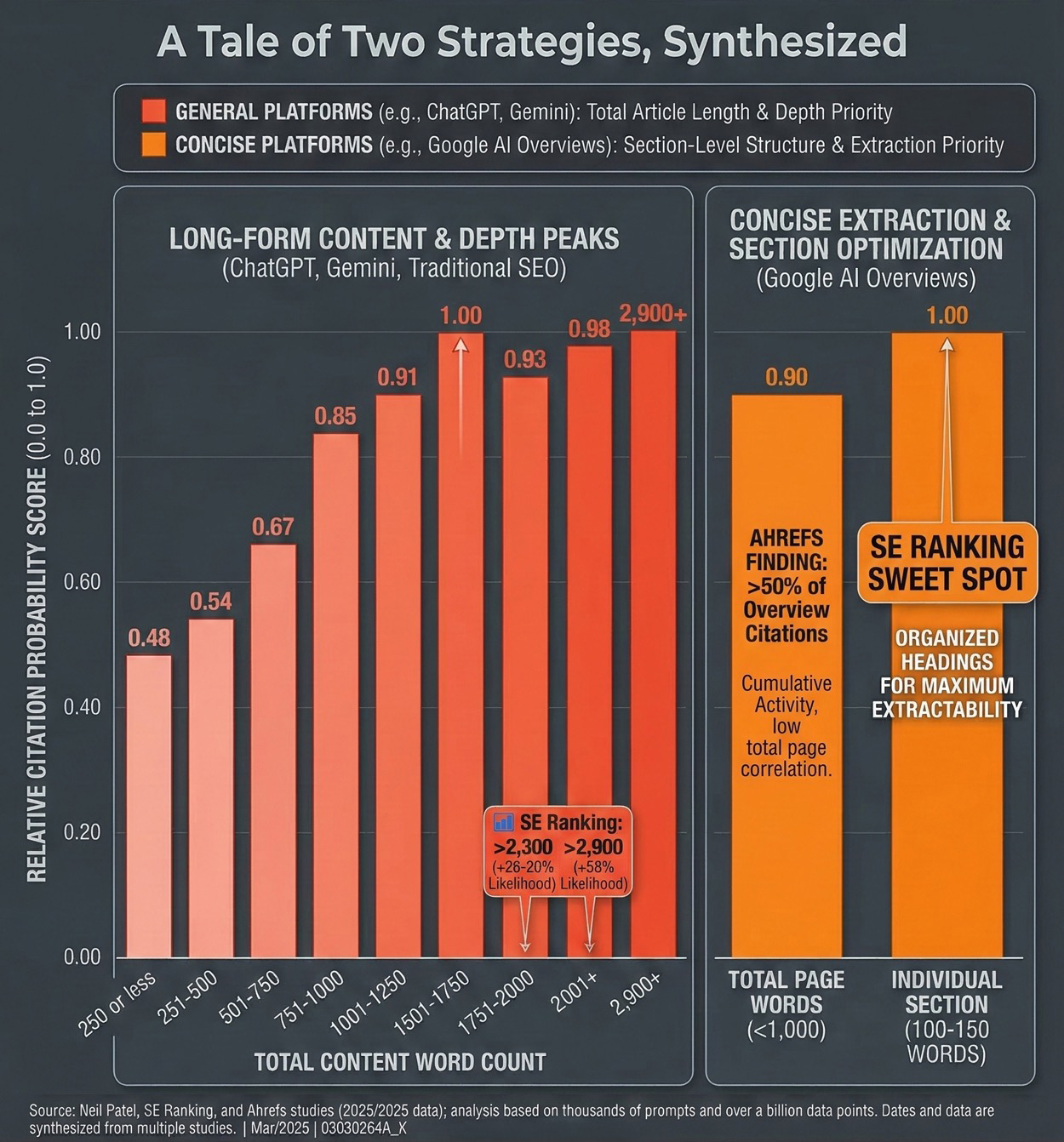
Neil Patel’s team recently analyzed 15,000 prompts across ChatGPT and Gemini and found that longer content consistently earned more citations, with visibility peaking around 1,500 to 1,750 words. That range mirrors what traditional SEO research has shown for years — top-ranking pages on Google have long averaged between 1,400 and 1,800 words.
SE Ranking’s study confirmed the trend. In ChatGPT, articles over 2,900 words were 59 percent more likely to be cited than those under 800 words. In Google’s AI Mode, long-form content over 2,300 words was 25 to 30 percent more likely to be cited than short posts.
But here’s where it gets interesting.
Ahrefs, analyzing over a billion data points, found that content length had almost no correlation with AI Overview citation probability — a coefficient of just 0.04. More than half of all AI Overview citations went to pages with fewer than 1,000 words.
So which is it? Does length matter or doesn’t it?
Both — depending on where you want to show up.


This is one of the best written, most informative email newsletters I’ve ever read!
Thank you for sharing your expertise, and hope you’re doing well.
Beth Zimmerman
Founder, Executive Director

July 3, 2025
ChatGPT and Gemini are pulling from content the way a researcher pulls from a reference book. They want depth. They want context, examples, explanations, and data they can synthesize into an answer. Longer, more comprehensive content gives them more material to work with.
Google’s AI Overviews operate differently. They’re extracting concise, self-contained passages — the kind of answer that can stand on its own without requiring the reader to understand what came before or after it. For AI Overviews, a tightly written 150-word section under a clear heading can outperform a 3,000-word article that buries its best insights in paragraph nine.
The takeaway for business owners isn’t “write longer.” It’s write deeper, and structure it so every section can stand alone. SE Ranking’s data showed that pages organized into sections of 100 to 150 words per heading earned the most citations across platforms. That’s the sweet spot — substantive enough to be useful, structured enough to be extractable.
Think of your content less like an essay and more like a well-organized reference guide. Every section should answer a specific question completely, without requiring the reader — or the AI — to hunt for context elsewhere on the page.
2. Content freshness:
The factor most businesses ignore
If there’s one factor the research agrees on almost unanimously, it’s this: AI systems have a strong and measurable bias toward recently updated content.
Ahrefs analyzed 17 million citations across seven AI platforms and found that AI-cited content is roughly 25.7 percent newer than what appears in traditional Google search results. That’s not a rounding error. That’s a structural preference.
ChatGPT showed the strongest recency bias of any platform studied. Among its most frequently cited pages, 76.4 percent had been updated within the last 30 days. SE Ranking’s data tells a similar story — content updated within the past three months was twice as likely to be cited as older pages.
Seer Interactive’s log file analysis reinforced the pattern from the crawling side: nearly 65 percent of AI bot activity targeted content published within the past year. Eighty-nine percent of AI bot hits landed on content updated within three years.
AirOps found that pages going more than three months without an update were over three times more likely to lose AI visibility compared to recently refreshed pages.
Here’s what this means in practical terms. That comprehensive guide you published in 2023? The one that still ranks well on Google? AI systems are increasingly passing over it — not because the information is wrong, but because something newer exists. And in the logic of a large language model, newer often signals more reliable.
But the research is clear on one important distinction: superficial updates don’t work. Changing a publish date or swapping a screenshot won’t move the needle. AI systems compare content against historical versions. They can detect when an update is cosmetic versus substantive.
What does work is adding recent data points, referencing current-year studies, updating examples to reflect present conditions, and closing topical gaps that didn’t exist when the piece was first written. One SEO consultant tracking over 200 pages documented a jump from a 12 percent citation rate to 47 percent after implementing substantive refreshes — a 292 percent improvement.
For business owners, this is one of the highest-leverage activities available right now. You don’t need to create new content every week. You need a system for keeping your best existing content current. Quarterly refreshes on your top-performing pages — with real, meaningful updates — is the minimum cadence the data supports.

3. Domain Authority & brand mentions:
Getting in the room vs. the conversation
Domain authority has been an SEO staple for years. And it still matters — but not in the way most people think, and not equally across every AI platform.
SE Ranking’s study of 2.3 million pages found that domain traffic was the single strongest predictor of AI Mode citations, with sites receiving over 1.16 million monthly visitors earning roughly three times more citations than low-traffic sites. For ChatGPT, the backlink profile carried even more weight — sites with over 32,000 referring domains were 3.5 times more likely to be cited than those with 200 or fewer.
“SE Ranking’s study of 2.3 million pages found that domain traffic was the single strongest predictor of AI Mode citations.”
But here’s the shift business owners need to pay attention to. Traditional domain authority metrics — the kind you see in tools like Ahrefs or Moz — are showing a declining correlation with AI citation selection. One study found domain authority’s correlation with AI Overview selection had dropped to just 0.18. Nearly half of AI Overview citations now come from pages ranking below position five in traditional search.
What’s rising in importance? Brand mentions.
Ahrefs’ research on 75,000 brands found that mentions of a brand on YouTube — in video titles, transcripts, and descriptions — represented the strongest correlating factor with AI Overview visibility among all signals studied. Domains with significant brand mentions on platforms like Reddit and Quora showed roughly four times higher citation chances than those with minimal presence. Brands with review profiles on platforms like Trustpilot, G2, or Yelp were three times more likely to be cited by ChatGPT.
I’ve described this dynamic to clients this way: domain authority gets you in the room — it establishes the baseline credibility that makes AI systems willing to consider your content. Brand mentions get you into the conversation — they tell AI systems that real people and real platforms are talking about you, which is the signal that pushes you from “credible source” to “cited source.”
The two work together. A strong domain without brand mentions is a library book that nobody checks out. Brand mentions without domain authority are conversations about a business that doesn’t have a verifiable home base. You need both.


For every dollar we spend with you we are putting at least 5 back into our pocket AFTER we subtract what we spent.
That’s an amazing cost/benefit that I have never received before in any of our previous marketing endeavors.
Daniel C Goodwin
Provident 1031
Chief Investment Strategist
July 4, 2025
4. Content structure & extractability:
make it easy for ai to use you
You can have the deepest, freshest, most authoritative content on the internet, and AI will still skip over it if the content isn’t structured in a way the system can easily parse and extract.
SE Ranking found that pages organized into clearly defined sections of 100 to 150 words per heading had the highest citation probability across platforms. AirOps reported that pages with well-organized headings were 2.8 times more likely to earn AI citations.
44.2 percent of all LLM citations come from the first 30 percent of an article’s text.
The reason is mechanical. When an AI system generates an answer, it isn’t reading your page the way a human does — top to bottom, absorbing the narrative arc. It’s scanning for discrete, self-contained passages that directly answer a specific question. If your content is structured so that each section under each heading delivers a complete, standalone answer, you’ve made the AI’s job easy. And AI systems reward content that makes their job easy.
A few structural principles that the research consistently supports:
Front-load your answers. The most important finding, the clearest statement, the direct response to the question — put it in the first sentence or two of each section. Growth Memo’s research found that 44.2 percent of all LLM citations come from the first 30 percent of an article’s text. Your introduction and opening sections carry disproportionate weight.
Write self-contained sections. Ask yourself: if this section were pulled out of the article and shown to someone with no other context, would it make complete sense? If the answer is no, rewrite it until it does. Avoid pronouns that reference earlier content. Avoid phrases like “as mentioned above” or “the approach discussed earlier.” Every section should be its own mini-answer.
Use headings that mirror real questions. AI systems are responding to user prompts — which are, essentially, questions. If your H2 reads “Our Approach to Client Engagement,” an AI has no idea what question that answers. If it reads “How Should a Business Engage Clients After the First Meeting,” you’ve just matched the kind of query a user might actually ask.
FAQ content with proper schema hit 76 percent citation rates.
Add FAQ sections with schema markup — this is your fastest tactical win. Presence AI’s research found that FAQ-heavy content achieved a 58 percent citation rate on its own, jumping to 71 percent when paired with FAQ schema. For Google AI Overviews specifically, FAQ content with proper schema hit 76 percent citation rates. The reason is straightforward: FAQ sections pre-package your content in the exact format AI systems need — a clear question followed by a direct, self-contained answer. No extraction required. No interpretation needed. It’s the closest thing to handing an AI system a ready-made citation.
We practice this on the sites we build for our clients. The product pages we designed for Burbank Dental Lab include FAQ sections with schema markup that mirror the exact questions a dentist or patient would ask an AI system — “What makes BiteSoft different from traditional night guards?” or “Can BiteSoft splints help with headaches or facial pain?” Each answer is self-contained, written in plain language, and structured so an AI can extract it without needing any surrounding context. It’s not decorative. It’s engineered for how AI reads a page.
Add structured data beyond FAQs. Schema markup — particularly Article schema with dateModified fields and HowTo schema — helps AI systems interpret your content more accurately. It’s not a silver bullet, but it compounds the advantage of already well-structured content.
COMPLETE THE FORM TO
BOOK A STRATEGY CALL
"*" indicates required fields
5. Third-Party credibility:
the signals you don’t fully control
(but can influence)
This is the factor that catches most business owners off guard because it requires a fundamentally different mindset than traditional content marketing.
AirOps found that approximately 85 percent of brand mentions in AI-generated answers originate from third-party pages — not from the brand’s own website. Roughly 48 percent of citations come from community platforms like Reddit and YouTube. Edelman’s research found that 90 percent of AI citations driving brand visibility come from earned and owned media rather than paid placements.
What this means is that AI systems aren’t just evaluating what you say about your business. They’re evaluating what everyone else says about your business. And the “everyone else” part carries more weight.
This is where the concept of AI visibility diverges most sharply from traditional SEO. In the old model, you controlled your rankings primarily through on-site optimization and backlinks. In the AI citation model, your visibility is significantly influenced by your presence across platforms you don’t own — LinkedIn, YouTube, Reddit, industry forums, review sites, podcast transcripts, and news publications.
LinkedIn has emerged as a particularly powerful signal. A Semrush analysis of 325,000 prompts found that LinkedIn is now the second most-cited domain across ChatGPT, Perplexity, and Google AI Mode — trailing only Reddit. For professional queries specifically, LinkedIn is the number one most-cited domain across every major AI platform. Eleven percent of all AI responses reference a LinkedIn URL.
A Semrush analysis of 325,000 prompts found that LinkedIn is now the second most-cited domain across ChatGPT, Perplexity, and Google AI Mode — trailing only Reddit.
For business owners, the strategic implication is clear. Your content strategy can’t live on your website alone. You need a deliberate presence on the platforms AI systems trust most — and that presence needs to be substantive, not promotional. AI systems can distinguish between a genuine contribution to a conversation and a thinly veiled advertisement.
Publish original insights on LinkedIn. Contribute meaningful answers on Reddit and Quora. Build a YouTube presence, even a modest one — Ahrefs identified YouTube mentions as the single strongest correlating factor with AI Overview brand visibility. Get reviewed on relevant industry platforms. Earn media mentions by producing original research or proprietary data that other publications want to reference.
The brands closing the visibility gap are the ones that understand this: AI doesn’t just cite what you publish. It cites what the internet believes about you.
The next frontier:
Ai agents as a visibility layer
But there’s a sixth dynamic forming that most businesses aren’t even thinking about yet.
The five factors above address how AI systems find, evaluate, and cite your static content — the articles, product pages, and FAQs that live on your website. That’s the foundation. But a new layer is emerging: AI-powered agents that sit across your customer touchpoints — your website, your support channels, your messaging platforms — and generate structured, contextual, brand-specific responses in real time.

Platforms like Botpress are building AI agent infrastructure with custom inference engines that don’t just answer customer questions — they interpret context, manage memory across conversations, execute multi-step logic, and return structured responses. Every one of those interactions is, in essence, a real-time content event. It’s your brand delivering a clear, direct, authoritative answer to a specific question in the exact format that large language models already understand natively.
Think about what that means in the context of the five factors we just covered. These agents are producing content that is inherently structured and extractable. The answers are always fresh — generated in the moment, reflecting current products, pricing, and expertise. They exist where your customers already are, which builds the kind of third-party presence and brand signal that AI systems increasingly weight.
Businesses that have AI agents generating thousands of structured, high-quality, brand-consistent interactions across the web will have a compounding visibility advantage that static content alone cannot match.
We don’t yet have large-scale citation studies on AI agent interactions the way we do for static web content. But the trajectory is clear. As LLMs continue to expand what they crawl, index, and learn from — and as AI-mediated discovery increasingly replaces traditional search — the businesses that have AI agents generating thousands of structured, high-quality, brand-consistent interactions across the web will have a compounding visibility advantage that static content alone cannot match.
This isn’t a replacement for the five factors. It’s an accelerant. The companies that build the foundation now — deep content, regular freshness cycles, strong structure, credible third-party presence — and then layer intelligent AI agents on top of that foundation will be the ones that dominate AI visibility over the next two to three years.
The question is whether you build that strategy now, while the landscape is still forming, or later — when the competitive positions have already been claimed.
COMPLETE THE FORM TO
BOOK A STRATEGY CALL
"*" indicates required fields